Applications are now open for the Academic Session 2026-27.
Open
Applications are now open for the Academic Session 2026-27.
Applications are now open for the Academic Session 2026-27.
Applications are now open for the Academic Session 2026-27.

Join the 12-month Health Sanitary Inspector course at MDESDS. Gain vital public health skills through hybrid learning and launch a secure career today.
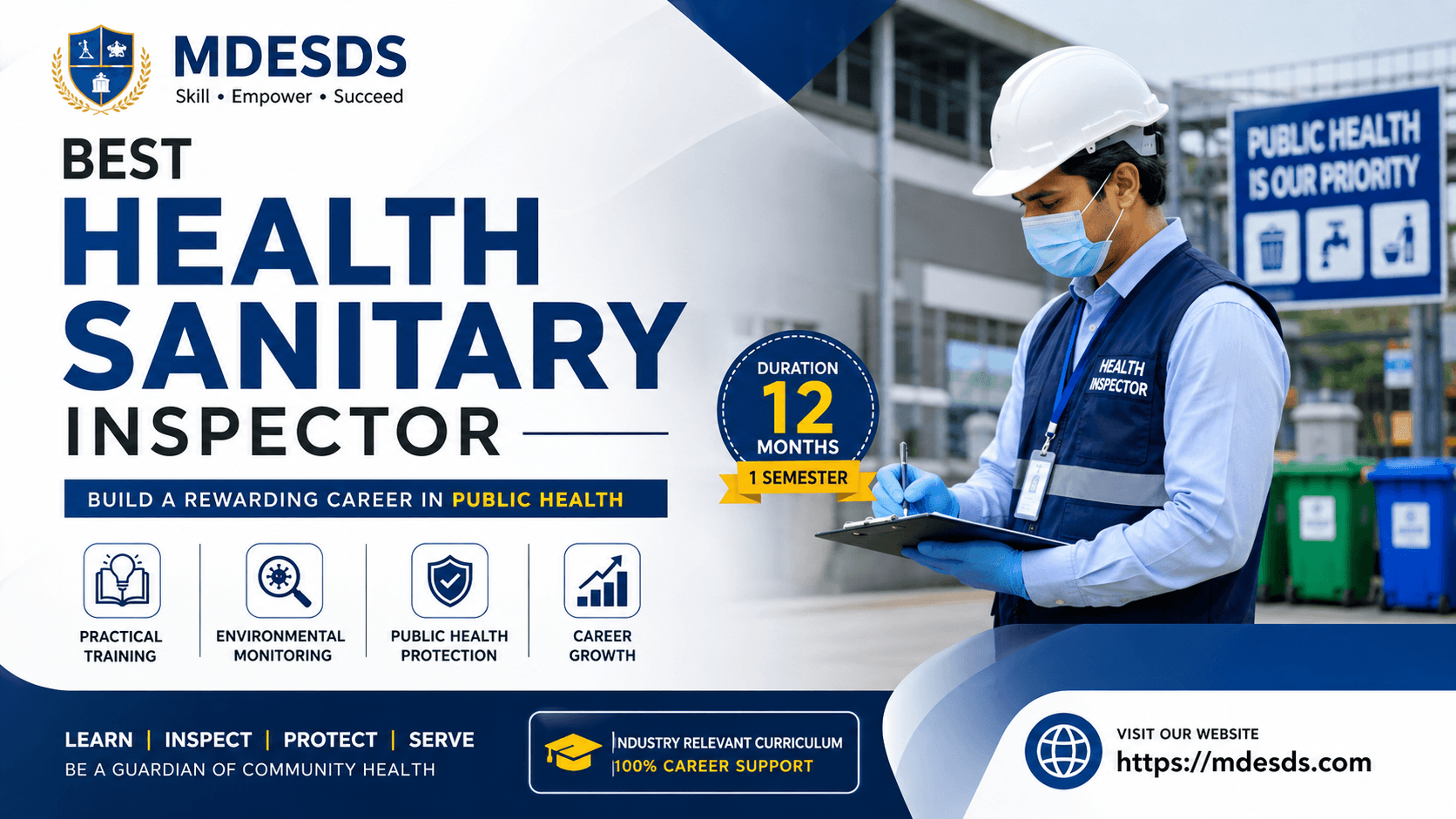
Public health and environmental hygiene have become the absolute backbone of sustainable community development. As cities expand and industrial zones multiply, the need for qualified professionals who can monitor, maintain, and enforce sanitation standards is at an all-time high. The Health Sanitary Inspector course offered by MDESDS is a specialized professional program meticulously engineered to bridge the gap between community health needs and trained administrative personnel.
This comprehensive program equips students with the technical acumen, regulatory knowledge, and practical field skills required to protect populations from environmental hazards, infectious disease outbreaks, and unhygienic practices. Offered through a highly flexible learning model, this course prepares you to step into crucial roles across government departments, private corporations, non-governmental organizations, and healthcare facilities.
A Health Sanitary Inspector is a certified public health professional responsible for safeguarding environmental health and community hygiene. These professionals act as the first line of defense against preventable diseases by monitoring water supply safety, waste management protocols, food hygiene, and overall environmental sanitation.
Far from being a purely desk-bound role, an inspector is an active field official. They conduct rigorous site audits, investigate public health nuisances, implement mass immunization drives, and ensure that public spaces—ranging from railway stations and airports to hotels and manufacturing plants—comply strictly with state and national health safety guidelines. In essence, they translate complex public health policies into everyday community safety.
The structural design of the Health Sanitary Inspector program at MDESDS focuses heavily on core conceptual clarity matched with actionable operational skills. Spanning a streamlined duration of 12 months, the curriculum is compacted into a high-impact learning sequence designed to maximize market readiness.
Delivered through a modern hybrid learning mode, students can balance interactive online theoretical lectures with critical on-site practical assignments and field workshops. This hybrid approach ensures you get the flexibility of digital education without losing out on essential hands-on training.
The initial phase of the 12-month program focuses on building core scientific awareness and understanding the systemic framework of public healthcare administration.
Human Anatomy And Physiology
What you will study: This subject covers the structural organization of the human body, organ systems, cellular functions, and the physiological impact of external pathogens and environmental toxins.
Practical Benefits: Understanding how the human body reacts to unhygienic environments allows an inspector to identify early signs of vector-borne illnesses, respiratory hazards, and waterborne infections within a community.
Skills Gained: Biological health screening, hazard vulnerability assessment, and professional medical terminology proficiency.
Community Health & Nutrition
What you will study: Exploration of epidemiology, dietary requirements across various demographics, nutritional deficiencies, public immunizations, and the control of communicable and non-communicable diseases.
Practical Benefits: You will be capable of designing local nutritional interventions, organizing targeted health camps, and tracking disease transmission vectors in densely populated zones.
Skills Gained: Community health mapping, demographic data collection, and nutritional deficiency diagnosis monitoring.
Environmental Sanitation
What you will study: Deep dive into solid and liquid waste management, sewage treatment processes, safe drinking water purification methods, pest and rodent control, and industrial hygiene protocols.
Practical Benefits: This forms the absolute core of daily field operations. You will know exactly how to inspect municipal water lines, evaluate landfill management, and enforce clean air and soil protocols.
Skills Gained: Water quality testing, waste audit profiling, sanitation risk assessment, and vector eradication planning.
Public Health Administration
What you will study: An extensive overview of healthcare infrastructure, national health policies, urban and rural local bodies (municipalities), sanitation laws, and legal frameworks governing public health.
Practical Benefits: Enables you to navigate government bureaucracy seamlessly, issue legal notices for sanitation violations, and maintain official public health registers efficiently.
Skills Gained: Regulatory compliance auditing, official report writing, health policy interpretation, and statutory enforcement.
Behavioural Science & Communication
What you will study: Principles of sociology, community psychology, educational methodology, and mass media communication strategies designed to alter public health habits.
Practical Benefits: Enforcing rules is only half the battle; driving mindset shifts is the other. This subject teaches you how to educate communities on open-defecation elimination, hand hygiene, and source segregation of waste.
Skills Gained: Public speaking, crisis communication, community mobilization, and counseling.
The Health Sanitary Inspector course is an exceptional fit for individuals driven by a desire to improve community welfare while securing a stable, highly respected professional career.
This program is highly recommended for:
High School Graduates (10+2): Students from any stream looking for a quick, direct pathway into government and private sector jobs within just 12 months.
Aspiring Healthcare Workers: Individuals who want to work in medicine and healthcare but prefer field operations, administration, and environmental safety over clinical nursing or laboratory desk jobs.
Civic-Minded Individuals: Anyone passionate about sustainability, clean environments, eco-friendly waste management, and social work.
Choosing to become a certified Health Sanitary Inspector through MDESDS offers immediate personal and professional rewards:
Accelerated Career Entry: With a duration of just 12 months, you can transition from an entry-level student to a certified professional ready for active employment.
Flexible Hybrid Learning Mode: The hybrid structure allows working professionals or students pursuing other degrees to comfortably upskill without altering their daily schedules.
Recession-Proof Career Path: Public health, waste management, and sanitation enforcement are essential public services. Economic downturns do not reduce the global mandate for clean water, safe food, and disease prevention.
High Practical Component: The course transitions fluidly from theoretical frameworks to real-life case studies, mock inspections, and field visits, making you highly confident from day one on the job.
The career trajectory for a certified Health Sanitary Inspector is incredibly diverse, offering excellent job security across both the public and private sectors. Every municipality, transport hub, and major hospital requires certified professionals to manage their health compliance.
Health Sanitary Inspector / Food Inspector: Working with municipal corporations to monitor local restaurants, public water points, and street hygiene.
Sanitation Superintendent: Overseeing massive solid waste management networks and cleaning workforces within smart city projects.
Public Health Officer: Collaborating with state health departments to monitor disease outbreaks and run vaccination drives.
Environmental Health Safety (EHS) Officer: Employed by private manufacturing units, pharmaceutical plants, and construction firms to maintain workplace hygiene and waste disposal standards.
Hygiene Manager: Managing infection control and waste protocols in luxury hospitality groups, major commercial malls, and corporate tech parks.
Future Prospects: After completing this 12-month foundational course, professionals can easily transition into advanced roles by pursuing specialized certifications in industrial safety, environmental hazard management, or a full degree in Public Health Administration.
MDESDS stands out as a premier destination for vocational and professional healthcare education. Our institutional approach prioritizes industry-aligned training engineered to make students immediately hirable.
Industry-Validated Curriculum: Our syllabus is constantly updated to reflect modern sanitation methodologies, updated municipal laws, and current global environmental standards.
Expert Academic Faculty: Learn directly from seasoned public health professionals, environmental experts, and administrative officers who bring real-world field insights into the hybrid classroom.
Comprehensive Student Support: From step-by-step guidance through our hybrid learning portal to resume building and placement assistance, MDESDS remains fully invested in your career growth.
Affordable, Accessible Education: We believe high-quality career training shouldn't be financially prohibitive. Our courses are optimized to provide maximum value and ROI.
Do not leave your professional future to chance. Secure a career path that offers stability, community impact, and continuous growth. Admissions for the upcoming batch of the Health Sanitary Inspector course are now officially open at MDESDS.
The Health Sanitary Inspector course is designed to provide practical knowledge, professional skills, and industry-relevant training. With a duration of 12 Months, this program helps students develop the expertise required for academic and professional success.
Launch your hospitality career with MDESDS's 12-month Diploma in Food & Beverage Service. Gain hands-on skills through h...
Earn an Advance Diploma In Play Center Management from MDESDS. 12-month hybrid course covering child care, development, ...
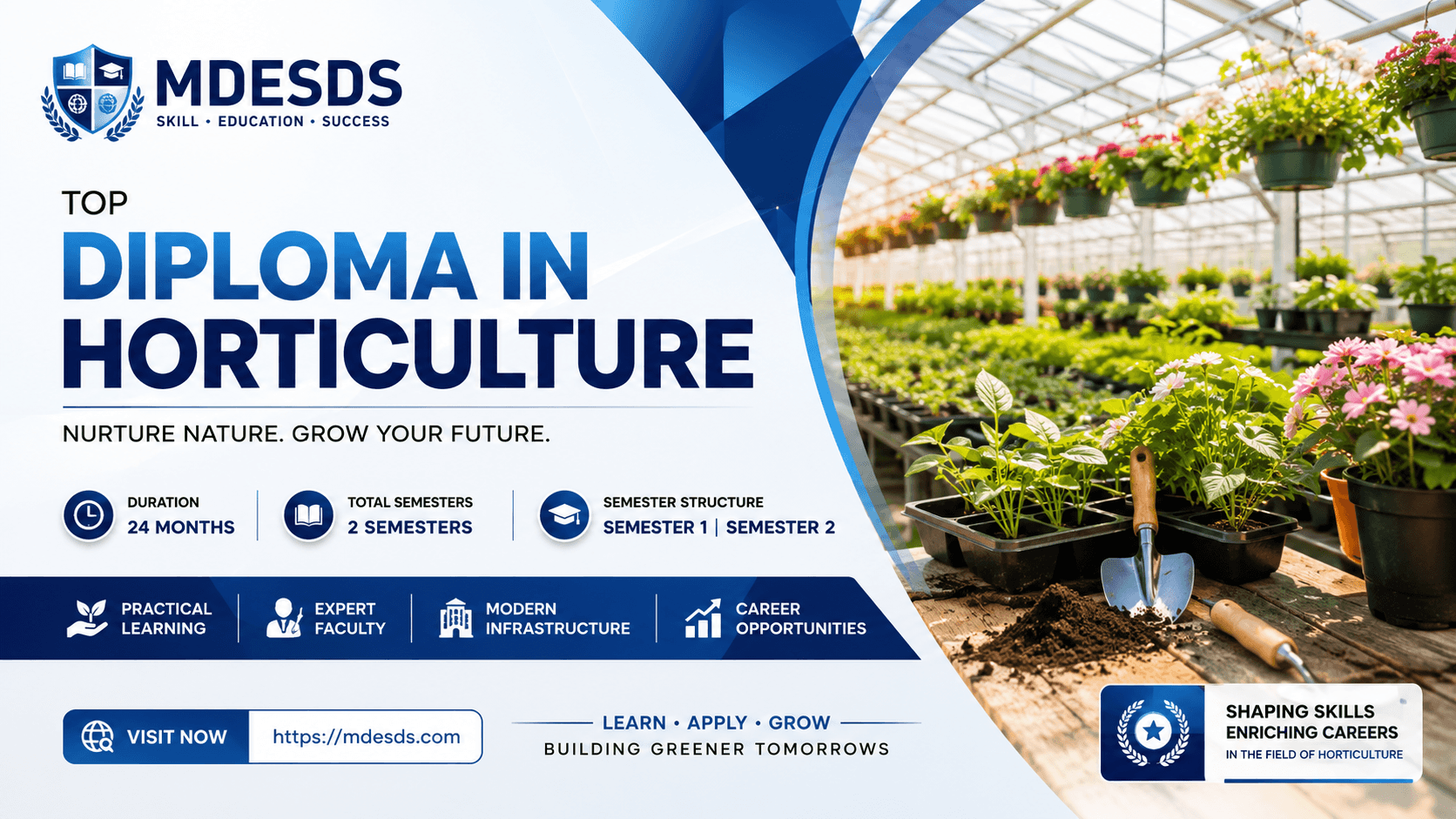
Advance your green career with MDESDS. Discover a 12-month hybrid Diploma In Horticulture, blending core plant science w...
Join MDESDS and build a successful future with industry-recognized diploma, certificate, vocational, and professional training programs. Limited seats available for the current academic session. Apply today and take the next step toward your career goals.