Search Our Courses





No matching course found.
No matching course found.

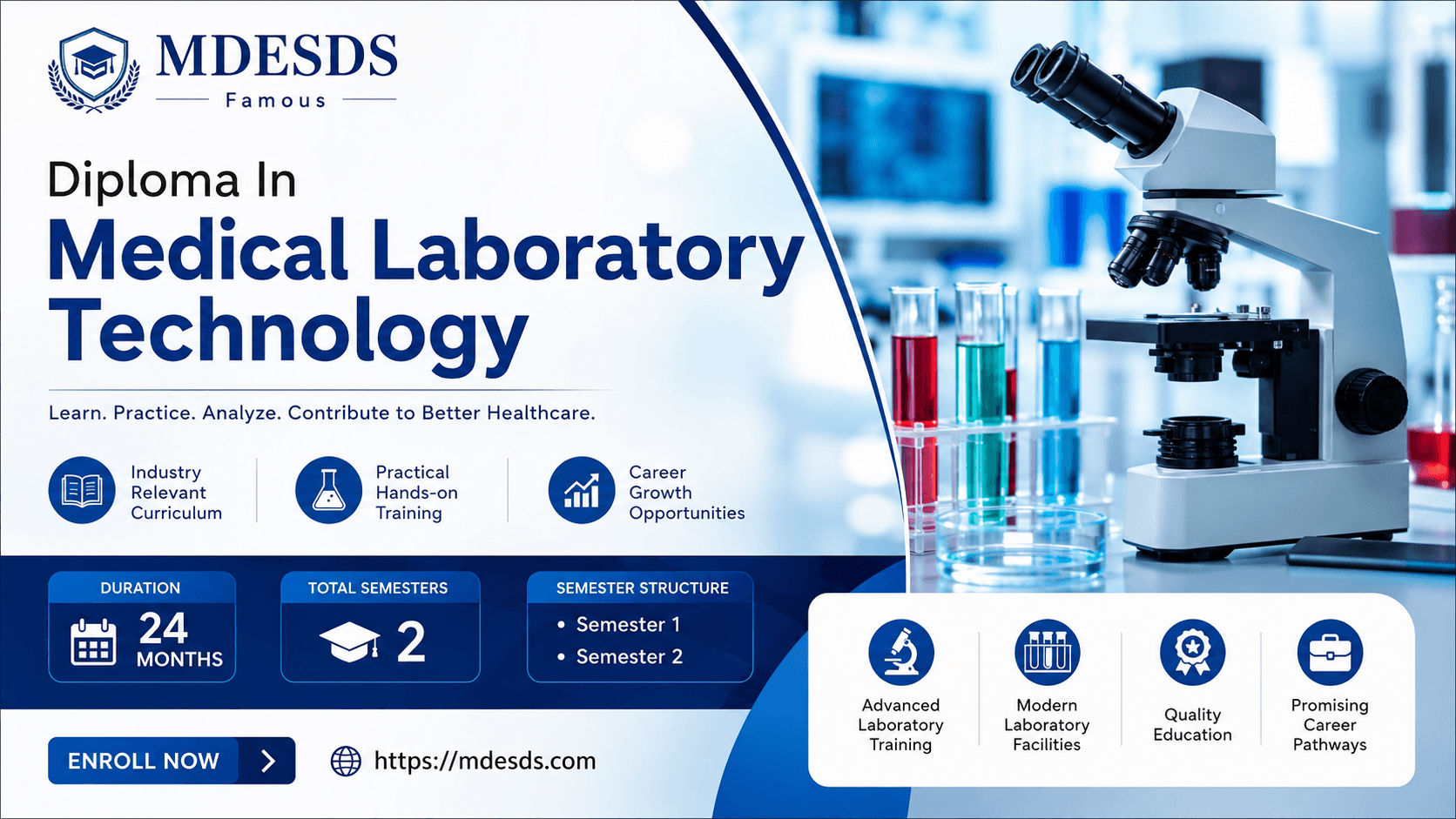
Build a successful career in healthcare with our 24-month hybrid Diploma In Medical Laboratory Technology. Gain hands-on skills and global job opportunities.
The healthcare sector is expanding at an unprecedented pace, and behind every accurate medical diagnosis, effective treatment plan, and saved life is a skilled laboratory professional. If you have a passion for science, a keen eye for detail, and a desire to make a meaningful impact on patient care without necessarily becoming a doctor or nurse, the allied healthcare sector offers incredible opportunities.
The Diploma In Medical Laboratory Technology offered by MDESDS is a comprehensive program designed to bridge the gap between theoretical medical science and practical laboratory diagnostics. In modern medicine, doctors rarely make clinical decisions without laboratory confirmation. From detecting minor infections to identifying complex conditions like cancer or diabetes, medical laboratory technicians are the backbone of diagnostic healthcare. By enrolling in this program, you choose a career path that offers job stability, high demand, and the immense satisfaction of serving society.
The Diploma In Medical Laboratory Technology (DMLT) is a specialized medical lab technologist program that trains students in the sophisticated art and science of performing laboratory tests. These tests are critical for the prevention, diagnosis, screening, and treatment of various diseases.
This professional course focuses on transforming students into proficient technicians who can handle advanced laboratory equipment, analyze biological specimens (such as blood, urine, tissue, and other bodily fluids), and report findings with absolute precision. At MDESDS, this program is structured to deliver deep technical knowledge combined with practical expertise, ensuring that you graduate as a day-one ready professional capable of working in high-pressure diagnostic environments.
To provide the perfect balance between personal flexibility and rigorous practical training, MDESDS offers the Diploma In Medical Laboratory Technology over a duration of 24 months via a flexible hybrid learning mode. This allows you to master theoretical concepts online at your own pace while attending intensive, hands-on practical sessions in state-of-the-art laboratories to master real-world diagnostic skills.
The curriculum is meticulously divided into two comprehensive semesters spanning across the 24-month duration. Below is the detailed breakdown of the subjects, the practical benefits they offer, and the specific skills you will acquire.
The first half of the program focuses on building a rock-solid foundation in human anatomy, basic chemical analysis, and the microscopic world of microorganisms.
Anatomy & Physiology
Practical Benefits: Understanding the normal structure and function of the human body is essential. This subject helps you understand where biological samples originate and how systemic diseases alter normal human physiology.
Skills Gained: Identification of human organ systems, understanding cellular pathology, and correlating physiological changes with diagnostic test requests.
Microbiology - I
Practical Benefits: This subject teaches you how to isolate, culture, and identify microscopic organisms like bacteria and fungi that cause infectious diseases. It is crucial for determining the exact cause of infections.
Skills Gained: Sterilization techniques, preparation of culture media, bacterial staining (such as Gram staining), and safe handling of pathogenic microorganisms.
Biochemistry - I
Practical Benefits: Biochemical analysis of blood and bodily fluids helps track metabolic functions. This subject covers the estimation of blood sugar, kidney function parameters, and liver enzymes.
Skills Gained: Operation of colorimeters and spectrophotometers, chemical analysis of blood serum, and calibration of automated biochemistry analyzers.
Haematology + Community Medicine
Practical Benefits: Haematology deals with the study of blood cells and coagulation factors, essential for diagnosing anemias and leukemias. Community medicine connects lab data to public health monitoring and epidemic prevention.
Skills Gained: Performing Total Leukocyte Counts (TLC), Differential Counts (DC), Hemoglobin estimation, and understanding epidemiological data collection.
Practical And Internal Assessment
Practical Benefits: This component integrates your classroom knowledge with physical laboratory practice, ensuring your manual dexterity and technical execution are up to industry standards.
Skills Gained: Real-time troubleshooting of laboratory errors, precise measurement techniques, and adhering to strict quality control protocols.
The second half of the 24-month program elevates your training to specialized testing methods, tissue analysis, and critical safety protocols required in advanced diagnostic centers.
Pathology (Histotechnology, Cytology, Museum Study)
Practical Benefits: This module focuses on processing tissue biopsies and cellular smears to detect cancerous changes and chronic cellular damage. Museum study helps in recognizing gross structural abnormalities in human organs.
Skills Gained: Tissue processing, microtomy (ultra-thin tissue slicing), slide staining (H&E staining), and fine-needle aspiration cytology (FNAC) slide preparation.
Blood Banking & Immunohaematology
Practical Benefits: Immunohematology is critical for life-saving blood transfusions. This subject ensures you can safely type blood, cross-match donor units, and prevent transfusion reactions.
Skills Gained: ABO and Rh blood grouping, cross-matching techniques, screening blood donor units for infectious diseases, and proper storage of blood components.
Clinical Pathology (Blood Fluids)
Practical Benefits: Beyond blood, the human body produces various fluids like cerebrospinal fluid (CSF), pleural fluid, and urine. Analyzing these provides deep insights into localized infections and metabolic disorders.
Skills Gained: Routine and microscopic examination of urine, semen analysis, and physical, chemical, and microscopic evaluation of sterile body fluids.
Laboratory Diagnosis, Biosafety Measures
Practical Benefits: Working in a lab exposes you to hazardous pathogens and chemicals. This subject trains you to protect yourself, your colleagues, and the environment while maintaining flawless diagnostic accuracy.
Skills Gained: Advanced biomedical waste management, chemical spill containment, post-exposure prophylaxis protocols, and running internal quality assurance programs.
Parasitological + Types Of Antigens
Practical Benefits: This deals with identifying parasitic infections (like malaria and amoebiasis) and understanding how the human immune system reacts to different types of antigens.
Skills Gained: Preparing thick and thin blood smears for malaria identification, stool examination for parasitic ova/cysts, and performing antigen-antibody serological tests (like Widal and ELISA).
The Diploma In Medical Laboratory Technology is an ideal choice for a diverse group of aspiring healthcare professionals:
Science Students (10+2): Individuals who have completed their high school education with a science background and want a direct, fast-track entry into the medical workforce.
Aspiring Healthcare Professionals: Anyone looking for a stable, recession-proof career in allied health sciences that offers a balance of technical work and patient impact.
Career Switchers: Professionals working in basic sciences or low-growth healthcare sectors who wish to specialize in diagnostics for better growth prospects.
Detail-Oriented Individuals: If you enjoy working with technology, microscopes, and high-precision instruments while solving medical mysteries, this course fits you perfectly.
Choosing to pursue your Diploma In Medical Laboratory Technology at MDESDS delivers tangible benefits designed to advance your professional journey:
Flexible Hybrid Learning: Our hybrid delivery model ensures that you do not have to put your life on hold. Learn the intricate theoretical frameworks from the comfort of your home, and visit our designated facilities for intensive clinical training.
Skill-Driven Curriculum: The course does not just rely on rote memorization. It focuses entirely on building marketable skills—like phlebotomy, tissue processing, and molecular diagnostics—that employers actively look for.
Confidence in Automation: Modern labs are highly automated. Our curriculum ensures you become comfortable operating semi-automated and fully automated analyzers, reducing your learning curve when you start your first job.
Focus on Safety & Ethics: MDESDS emphasizes patient data confidentiality, medical ethics, and global biosafety standards, preparing you to work in international-standard accredited labs (like NABL or CAP).
The career scope after completing a Diploma In Medical Laboratory Technology is vast and continues to expand globally. Every hospital, clinic, and public health department relies on lab technicians.
Medical Laboratory Technician (MLT): Performing routine and specialized diagnostic tests in hospital laboratories.
Lab Manager/Supervisor: Overseeing lab operations, managing inventory, and ensuring strict quality control adherence.
Blood Bank Technician: Working in blood donor centers, managing blood typing, component separation, and cross-matching.
Pathology Lab Assistant: Assisting senior pathologists in processing tissue biopsies and cytological samples.
Research Assistant: Working in pharmaceutical companies or medical research institutions to support clinical trials and vaccine development.
Product Specialist: Working with medical diagnostic equipment manufacturing companies to demonstrate and install lab analyzers.
After completing this 24-month diploma, you do not have to stop learning. You can easily transition into a Bachelor of Medical Laboratory Technology (BMLT), pursue post-graduate diplomas, or specialize in emerging fields like Molecular Biology, Genetics, or Immunodiagnostics, which open doors to managerial and high-paying research positions worldwide.
MDESDS stands out as a premier institution dedicated to vocational and allied health education. When you choose our Diploma In Medical Laboratory Technology, you are investing in a future-proof career backed by an institution that prioritizes student success.
Expert Faculty: Learn from experienced pathologists, microbiologists, and senior lab technologists who bring real-world clinical insights into your learning environment.
State-of-the-Art Infrastructure: Our practical training centers are equipped with modern laboratory equipment, giving you authentic experience on the instruments used in top hospitals.
Robust Student Support: From navigating the hybrid learning platform to coordinating your intensive practical sessions, our dedicated academic support team is with you every step of the way.
Placement Assistance: We don't just educate; we help you transition into the workforce. Our strong network within the healthcare sector assists students in securing internships and permanent job placements upon course completion.
Don't wait to build a career that offers stability, professional growth, and the power to save lives behind the scenes. Enroll in the Diploma In Medical Laboratory Technology at MDESDS and gain the skills that modern healthcare employers are actively looking for.
The Diploma In Medical Laboratory Technology course is designed to provide practical knowledge, professional skills, and industry-relevant training. With a duration of 24 Months, this program helps students develop the expertise required for academic and professional success.

Join the 12-month hybrid Diploma In Computer Science at MDESDS. Master coding, logic, and tech fundamentals. Build a hig...
Advance your career with our Diploma In Electracal And Electronics Technology. Gain hands-on skills through hybrid learn...

Master 2D drafting and 3D modeling with our 3-month Certificate In Auto Desk. Enjoy hybrid learning, expert guidance, an...
Join MDESDS and build a successful future with industry-recognized diploma, certificate, vocational, and professional training programs. Limited seats available for the current academic session. Apply today and take the next step toward your career goals.