Applications are now open for the Academic Session 2026-27.
Open
Applications are now open for the Academic Session 2026-27.
Applications are now open for the Academic Session 2026-27.
Applications are now open for the Academic Session 2026-27.

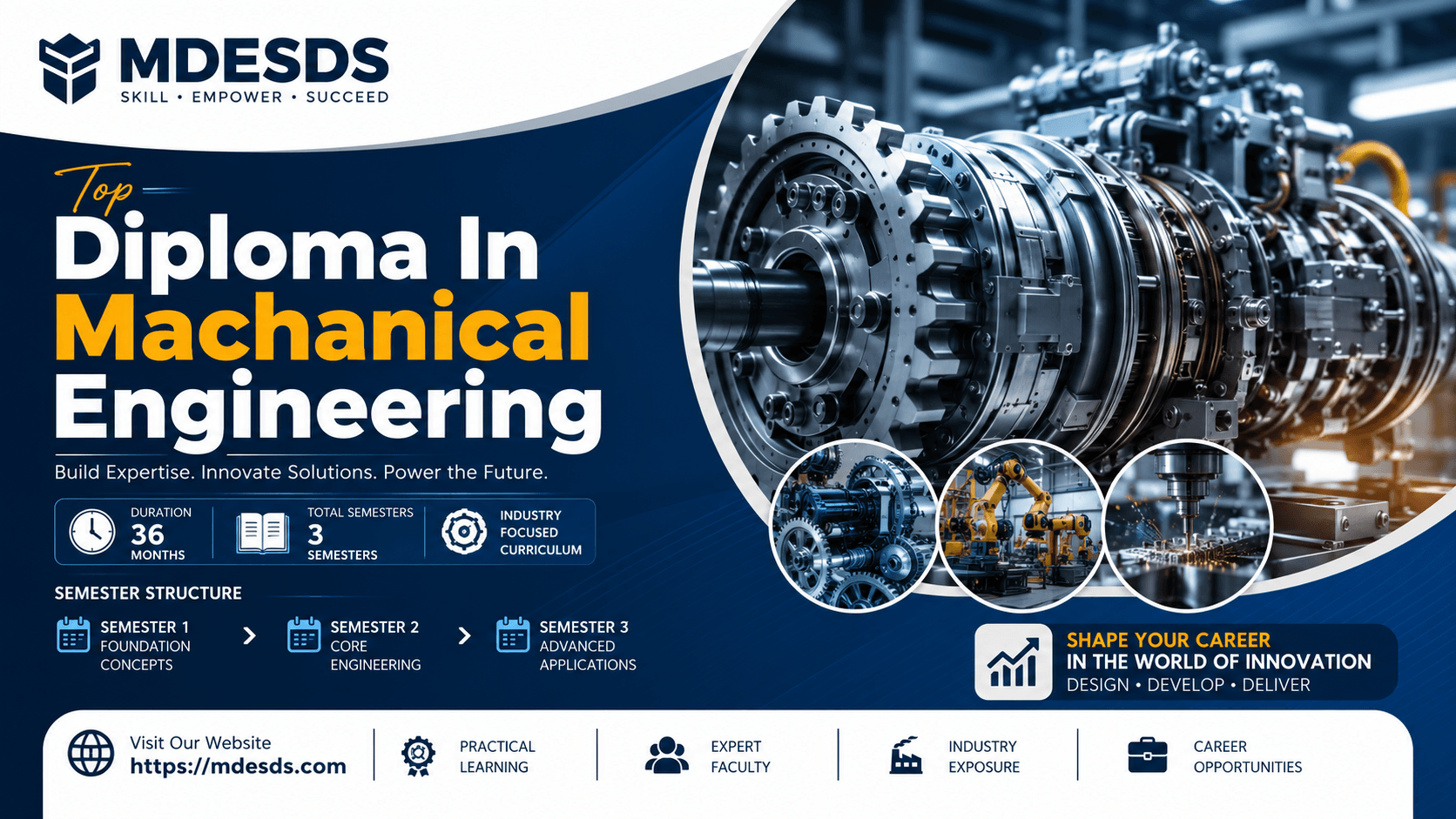
Gain hands-on expertise with MDESDS's 36-month Diploma In Machanical Engineering. Explore our hybrid syllabus, career scope, and practical skills.
The manufacturing, automotive, and aerospace industries are evolving at a breakneck pace. At the heart of this transformation are mechanical engineers—the problem solvers who turn conceptual designs into physical reality. If you have a passion for machines, a curiosity about how things work, and a drive to build a rewarding technical career, the Diploma In Machanical Engineering offered by MDESDS is your perfect launchpad.
This comprehensive program bridges the gap between foundational scientific principles and modern industrial applications. Designed by technical educators and industry experts, our course ensures that you do not just learn theory from a textbook; you develop the actual engineering capabilities demanded by modern global employers. Whether your goal is to optimize massive production lines or design next-generation thermal systems, this diploma sets a rock-solid foundation for long-term career growth.
A Diploma In Machanical Engineering is a specialized technical program focused on the design, analysis, manufacturing, and maintenance of mechanical systems. It serves as a highly practical alternative to traditional theoretical degrees, emphasizing real-world execution, workshop practice, and industrial readiness.
At MDESDS, this program is structured as a 36-month journey split into multiple progressive phases. By choosing our hybrid learning mode, you get the absolute best of both worlds. You can master theoretical frameworks, calculations, and software simulations through interactive online modules, while attending rigorous physical workshops and laboratory sessions for your hands-on technical training. This 36-month hybrid structure allows working professionals, diploma seekers, and young students to balance their academic pursuits with other personal or professional commitments without compromising on instructional quality.
Our curriculum is meticulously structured across its academic timeline to take you from a foundational engineering enthusiast to a skilled technical professional. Over the course of 36 months, students move systematically through core principles, advanced applications, and real-world industrial exposure.
Here is the comprehensive breakdown of the semesters, core subjects, practical benefits, and skills you will acquire throughout this program.
The initial phase of the Diploma In Machanical Engineering establishes the bedrock of mathematical modeling, physical laws, and material behaviors. Without these fundamentals, advanced manufacturing and design are impossible to master.
Practical Benefits: Every machine part, fluid pipeline, and structural beam requires exact mathematical validation before manufacturing. This subject trains you to handle engineering calculations, structural tolerances, and statistical quality control metrics used daily on the factory floor.
Skills Gained: Advanced problem-solving, algorithmic thinking, dimensional analysis, and the ability to compute complex geometric configurations for mechanical assemblies.
Practical Benefits: Understanding thermodynamics, mechanics, and material properties is vital for analyzing machine failures and stress points. This subject explains the physical laws governing energy, motion, and forces, which dictate how mechanical components behave under real-world stress.
Skills Gained: Proficiency in stress-strain analysis, kinetic energy calculations, wave mechanics, and thermal property testing of diverse engineering materials.
Practical Benefits: Before building a machine, a bridge, or a vehicular chassis, you must know exactly how much load it can bear before breaking or deforming. This subject teaches you how to evaluate internal stresses, bending moments, and structural integrity to ensure safety and durability.
Skills Gained: Capability to calculate material fatigue, design load-bearing components, select appropriate materials for specific industrial stresses, and use testing equipment like Universal Testing Machines.
The second phase shifts the focus toward energy systems, sustainability, and real-world exposure, allowing you to understand how modern facilities optimize their utilities and environmental footprint.
Practical Benefits: From domestic refrigerators to massive industrial cold storage units and pharmaceutical cleanrooms, temperature control is non-negotiable. This course provides deep insight into vapor compression cycles, eco-friendly refrigerants, and HVAC (Heating, Ventilation, and Air Conditioning) system architecture.
Skills Gained: Expert-level troubleshooting of cooling systems, thermal load calculations, HVAC duct design, and preventive maintenance of commercial chilling plants.
Practical Benefits: Modern industries face strict regulations to cut down power consumption and reduce carbon footprints. This subject teaches you how to perform energy audits, identify power leakages, and implement green engineering solutions that save corporations millions in operational costs.
Skills Gained: Conducting industrial energy audits, implementing renewable energy integrations, optimizing boiler and compressor efficiency, and mastering sustainability compliance.
Practical Benefits: Theory meets reality during the intensive Industrial Training module. Students step out of the classroom and onto actual production floors, assembly lines, or design studios. This exposure bridges the gap between academic hybrid learning and the fast-paced nature of real industrial operations.
Skills Gained: Professional workplace communication, understanding corporate hierarchy, real-time machine troubleshooting, quality assurance workflows, and project management fundamentals.
The final phase prepares you for leadership and high-tech roles, focusing on automation, computer-guided machinery, and the optimization of human and machine resources.
Practical Benefits: To design smooth, high-speed machinery like automotive engines or robotic arms, you must master relative motion, gear trains, links, and cam mechanisms. This subject teaches you how to translate raw power into precise, predictable physical movement.
Skills Gained: Velocity and acceleration analysis of mechanisms, gear profile designing, balancing of rotating masses, and vibration control in heavy machinery.
Practical Benefits: Traditional manufacturing has evolved into highly automated, software-driven ecosystems. This subject trains you on Computer Numerical Control (CNC) systems, automated manufacturing cells, and robotics, preparing you directly for smart factories and Industry 4.0 environments.
Skills Gained: Manual G-code and M-code programming, setting up CNC milling and turning centers, operating automated assembly components, and precision digital manufacturing execution.
Practical Benefits: A brilliant machine design is useless if it cannot be manufactured cost-effectively. Production management introduces you to supply chain dynamics, plant layouts, material handling, and lean manufacturing methodologies like Six Sigma and 5S.
Skills Gained: Capacity planning, inventory management, workflow optimization, labor costestimation, and implementing strict industrial safety protocols.
The Diploma In Machanical Engineering at MDESDS is designed for a highly diverse group of aspirants who want a rapid, skill-first entry into the engineering domain. This program is ideal for:
Fresh High School Graduates: Students looking for an affordable, highly practical, and quick pathway into technical careers rather than spending four years on purely theoretical degrees.
Working Technicians and ITI Graduates: Field professionals currently working in factories who want to upgrade their qualifications, unlock managerial promotions, and secure higher pay scales.
Aspiring Entrepreneurs: Individuals who want to establish their own precision machining workshops, fabrication businesses, HVAC maintenance agencies, or spare-parts manufacturing units.
Career Switchers: Professionals from adjacent technical fields who want a structural pivot into the booming automotive, robotics, or industrial automation sectors.
Investing 36 months in this program delivers measurable career advantages that set you apart in a crowded employment market:
Flexible Hybrid Framework: You don’t have to pause your life. Our hybrid learning mode allows you to balance existing jobs or family commitments while gaining premium engineering credentials.
Industry-Aligned Competencies: The integration of CNC automation, energy auditing, and industrial training ensures you step into interviews with skills that employers are actively searching for today.
Strong Analytical Foundation: By mastering solid mechanics and machine theory, you possess the structural troubleshooting skills required to solve unpredictable floor breakdowns.
Fast-Track Corporate Progression: Having a formal diploma accelerates your movement from basic ground-level assembly operator to technical supervisor, estimation engineer, or production manager.
Mechanical engineering is often called the "evergreen" branch of engineering for a reason: as long as things need to be built, moved, or automated, your skills will remain in high demand.
Upon completing your Diploma In Machanical Engineering, you can target vital roles across sectors like automotive, defense, power generation, HVAC, and manufacturing automation. Some of the most common career paths include:
| Job Role | Core Responsibilities |
| CNC Machine Programmer / Operator | Writing structural codes, setting up multi-axis CNC machines, and supervising precision component manufacturing. |
| HVAC & Maintenance Engineer | Designing, installing, and servicing commercial air conditioning, refrigeration, and ventilation setups. |
| Production Supervisor | Managing shop-floor assembly lines, ensuring worker safety, optimizing throughput, and maintaining quality standards. |
| Quality Control (QC) Inspector | Utilizing precision metrology tools to verify that manufactured parts perfectly match engineering blueprints. |
| Junior Design Engineer | Assisting senior engineers in creating 3D CAD models, drafting technical designs, and performing basic stress simulations. |
This diploma acts as an excellent stepping stone. Graduates are eligible for lateral entry directly into the second year of a Bachelor of Engineering (B.E.) or Bachelor of Technology (B.Tech) program, cutting down their overall higher education timeline.
MDESDS stands out as a premier institution dedicated to vocational and technical excellence. We understand that engineering cannot be mastered purely by looking at slides.
Experienced Pedagogy: Our faculty consists of seasoned engineers and industry veteran educators who bring years of real-world factory and design experience into the curriculum.
Advanced Learning Infrastructure: Through our hybrid delivery mode, we utilize advanced digital learning tools alongside fully equipped local workshop networks to provide true practical competence.
Affordable and Accessible Education: We believe high-quality technical education shouldn't create a lifetime of debt. Our program is structured to offer maximum value, flexible payment modules, and robust career support.
Comprehensive Student Support: From the day you enroll in your 36-month program to your final industry placement drives, MDESDS provides continuous mentorship, resume building, and interview preparation.
Do not let your career goals wait. Secure your place in our upcoming batch and start building the hands-on technical skills that industries around the globe rely on every single day.
Transform your passion for machinery into a lifelong professional career with MDESDS. Our admissions advisors are ready to walk you through the enrollment process, fee structures, and batch timings.
The Diploma In Machanical Engineering course is designed to provide practical knowledge, professional skills, and industry-relevant training. With a duration of 36, this program helps students develop the expertise required for academic and professional success.

Gain expertise with our Diploma In Computer Financial Accounting. Master modern accounting software, digital methods, an...

Elevate your career with our Advance Diploma In Business Management. Master leadership and strategy in a 12-month hybrid...
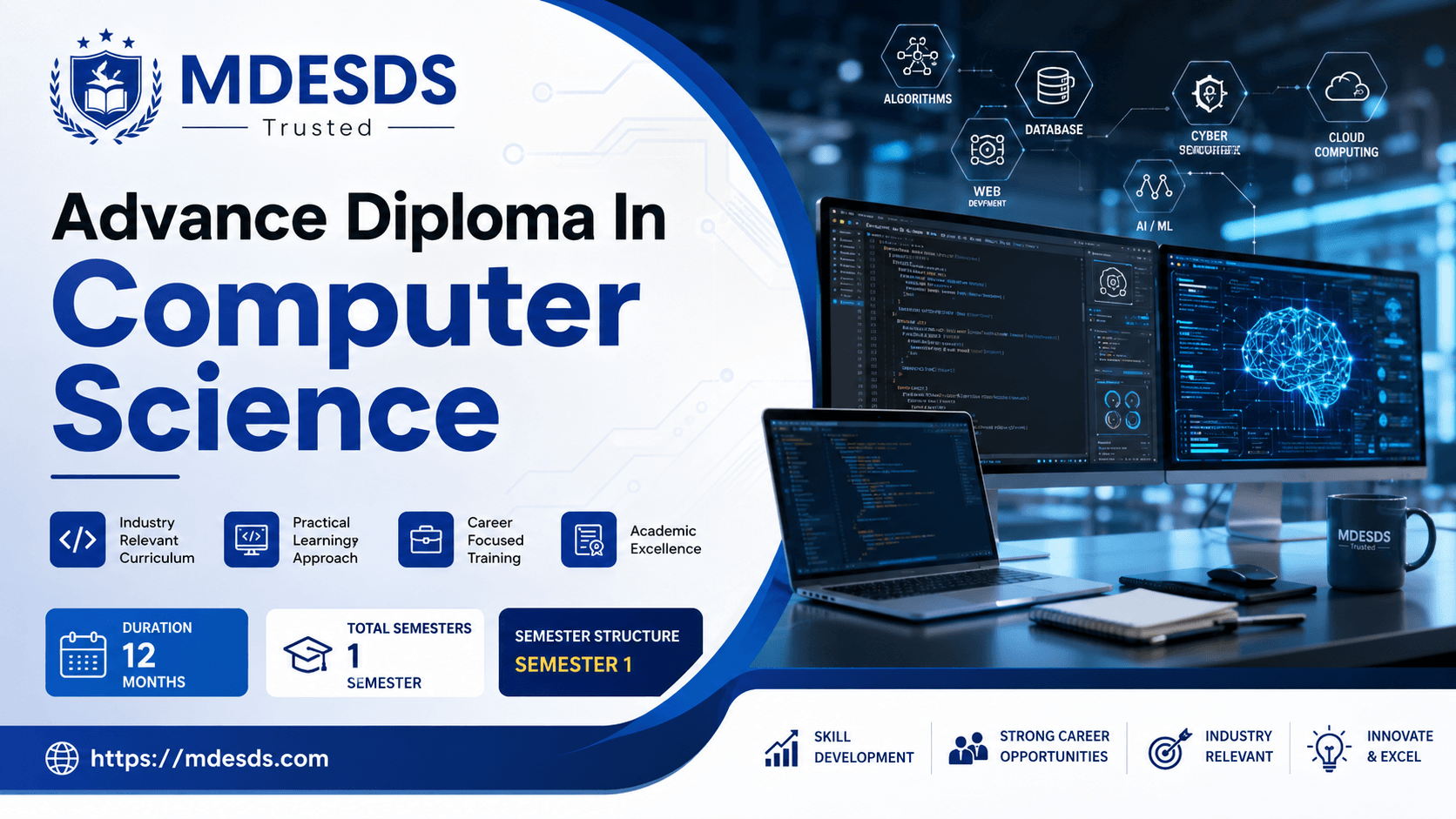
Launch your IT career with the 12-month Advance Diploma In Computer Science at MDESDS. Learn DSA, OS, and office tools t...