Search Our Courses







No matching course found.
No matching course found.

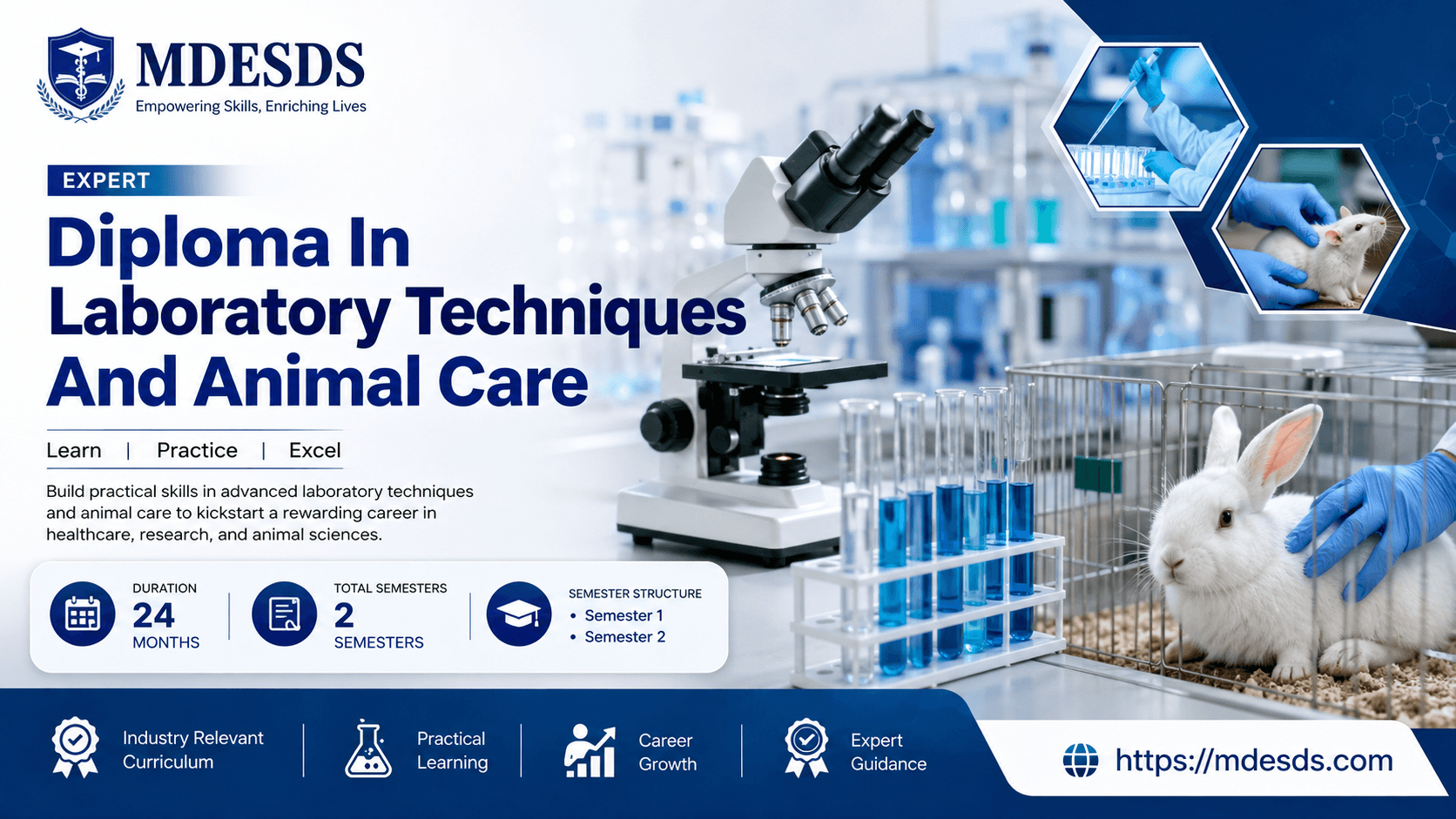
Master essential lab skills and animal handling with the 24-month Diploma In Laboratory Techniques And Animal Care at MDESDS.
The modern scientific landscape relies heavily on well-trained professionals who keep laboratories running safely, efficiently, and ethically. Whether it is a diagnostic medical facility, a pharmaceutical research center, or an academic institution, the demand for skilled laboratory technicians is at an all-time high.
If you have a passion for science, an eye for detail, and an interest in supporting vital research and healthcare initiatives, entering this field can open doors to a highly rewarding career. The comprehensive Diploma In Laboratory Techniques And Animal Care offered by MDESDS is meticulously designed to bridge the gap between theoretical science and hands-on operational expertise.
This professional program equips you with the exact technical proficiencies, safety protocols, and management skills required to excel in modern scientific setups. Let’s dive deep into what this course offers, the structured curriculum, and how it can transform your professional future.
The Diploma In Laboratory Techniques And Animal Care is a specialized, comprehensive 24-month program designed to train students in the core methodologies of scientific laboratories and the ethical management of research environments. This course blends foundational scientific principles from chemistry, biology, and physics with practical, real-world operational training.
Unlike generic science degrees, this diploma focuses intensely on applied skills. Students learn exactly how to manage sensitive lab equipment, handle chemical and biological hazards, maintain rigorous safety standards, and organize data systematically.
Delivered through a flexible hybrid learning mode, the program allows you to balance theoretical coursework online with crucial, hands-on practical sessions in real laboratory environments. Over its 24-month duration, the course transforms passionate learners into industry-ready technicians capable of supporting advanced scientific research and diagnostic workflows.
The Diploma In Laboratory Techniques And Animal Care spans two full years, structured into two comprehensive semesters. The curriculum is intentionally balanced to build your skills from fundamental laboratory safety to advanced biological and physical experimentation techniques.
Here is a detailed breakdown of the semesters, the subjects you will master, and the practical benefits and skills you will gain from each.
The first semester focuses on establishing a rock-solid foundation in laboratory protocols, structural management, and chemical experimentation. Understanding the rules of a lab environment is critical before handling complex biological or physical systems.
Lt- 1 Good Laboratory Practices (GLP): This subject introduces you to the international standard framework for ensuring the quality, integrity, and reliability of laboratory data.
Practical Benefits: You will learn how to properly document experiments, maintain reproducible records, and comply with legal regulatory standards.
Skills Gained: Data integrity management, regulatory compliance auditing, and precise documentation.
Laboratory Organisation And Management - 1: A laboratory is more than just test tubes; it is an organized workspace requiring careful inventory and operational planning.
Practical Benefits: You learn how to catalog assets, manage chemical logs, and understand the workflow layout of a high-functioning lab.
Skills Gained: Resource allocation, inventory tracking, and operational efficiency mapping.
Laboratory Organisation And Management - 2: Advancing from the first module, this section dives deeper into the administrative side of laboratory care, including equipment calibration schedules and team coordination.
Practical Benefits: Teaches you how to prevent equipment downtime and manage procurement pipelines.
Skills Gained: Preventative maintenance scheduling, technical troubleshooting, and supervisor-level team coordination.
Hazard In Laboratories + Laboratory Safety: Safety is the absolute priority in any scientific space. This module covers chemical burns, biohazard containment, radiation safety, and emergency response.
Practical Benefits: You will know exactly how to prevent accidents and how to act swiftly and safely if an unexpected spill or exposure occurs.
Skills Gained: Risk assessment, emergency first-aid protocols, hazard identification, and waste disposal management.
Basic Experiments In Chemistry: This hands-on chemistry module covers fundamental techniques such as titration, solution preparation, molarity calculations, and chemical synthesis observations.
Practical Benefits: Gives you the confidence to prepare precise chemical reagents needed by senior scientists without error.
Skills Gained: Volumetric analysis, reagent preparation, analytical weighing, and chemical safety handling.
The second semester shifts the focus toward living systems, microscopic observation, culture techniques, and the physics of laboratory instrumentation.
Lt -2 Laboratory Techniques In Biology: This core biological module teaches the primary protocols used in handling tissues, cellular samples, and physiological data.
Practical Benefits: Prepares you to assist directly in medical diagnostics, agricultural research, and veterinary labs.
Skills Gained: Physiological sampling, tissue preservation, and data recording for living systems.
Introduction To Biology Laboratories: An orientation into the specific layout, specialized equipment, and unique environmental controls required for biological specimens.
Practical Benefits: Understand how to maintain sterile fields and control ambient temperatures to prevent sample contamination.
Skills Gained: Sterilization protocols, environmental control monitoring, and biological asset logging.
Microscopy, Staining And Culture Techniques: One of the most exciting parts of the course, this subject covers the operation of advanced microscopes, gram staining methods, and growing bacterial or cellular cultures.
Practical Benefits: Directly applicable to medical pathology labs where identifying pathogens under a lens determines patient treatment plans.
Skills Gained: Brightfield and darkfield microscopy adjustment, bacterial smear preparation, differential staining, and aseptic culturing.
Laboratory Manual - Biology + Basic Experiments In Biology: A highly practical, workbook-driven module where you execute standard biological assays, test for biomolecules (proteins, lipids, carbohydrates), and document structural findings.
Practical Benefits: Solidifies your independent working capabilities in a lab, minimizing the need for constant supervision.
Skills Gained: Biomolecule testing, experimental verification, and professional laboratory manual charting.
Basic Apparatus & Experiments In Physics: Modern labs are filled with optoelectronic and physical instruments like spectrophotometers, centrifuges, and electrical measurement kits.
Practical Benefits: Demystifies the physical mechanics behind lab hardware, allowing you to use and calibrate high-tech machinery safely.
Skills Gained: Use of physical measurement tools, calibration of optical instruments, and understanding electrical safety parameters.
The Diploma In Laboratory Techniques And Animal Care is highly versatile, making it perfect for a wide range of individuals aiming for a stable, growth-oriented career. This program is ideal for:
High School Graduates: Students with a background or interest in science who want a fast-track, practical route into employment rather than spending 3–4 years on a purely theoretical degree.
Aspiring Healthcare Workers: Individuals who want to work behind the scenes in diagnostics, pathology, and medical research infrastructure.
Animal Lovers and Veterinary Enthusiasts: Those who want to ensure ethical, humane care and management for animals involved in scientific research and veterinary assistance.
Career Switchers: Professionals working in basic administrative or manufacturing roles who wish to transition into the stable, highly respected healthcare and research sectors through a flexible hybrid learning mode.
To enroll in this 24-month course, candidates typically need to have completed their higher secondary education (10+2) with science subjects (Biology, Chemistry, or Physics preferred) from a recognized educational board.
Enrolling in the Diploma In Laboratory Techniques And Animal Care provides clear professional and personal advantages that set you apart in the job market:
Flexible Hybrid Learning: The course architecture uses a hybrid learning mode, allowing you to study theoretical frameworks from the comfort of your home while dedicating specific slots for rigorous practical lab sessions.
High Market Relevance: The combination of strict lab organization skills and biological technique training is highly sought after by pharmaceutical companies, clinical trial groups, and universities alike.
Fast-Track Professional Entry: In just 24 months, you acquire a technical skillset that qualifies you for intermediate and specialized employment opportunities, reducing your time spent outside the workforce.
Focus on Ethics and Welfare: The curriculum emphasizes safe, humane laboratory practices, ensuring you approach animal care and bio-safety with empathy and professional responsibility.
Graduating with a Diploma In Laboratory Techniques And Animal Care provides you with a robust, versatile skillset that applies across multiple multi-billion-dollar industries.
Laboratory Assistant / Technician: Managing day-to-day operations, setting up experiments, and maintaining equipment in school, university, or corporate research labs.
Pathology Lab Assistant: Processing biological samples, running automated diagnostic machinery, and managing patient reports in diagnostic centers and hospitals.
Quality Control Analyst: Ensuring that raw materials, manufacturing environments, and finished products meet precise safety and regulatory guidelines in the food, beverage, or cosmetic industries.
Animal Care Specialist / Research Associate: Managing the health, nutrition, housing, and ethical compliance of animals involved in veterinary clinics, zoological settings, or biomedical research facilities.
Lab Safety and Compliance Officer: Monitoring safety protocols, managing biohazard disposal, and conducting internal audits to ensure laboratories meet legal requirements.
The scope for laboratory professionals is expanding rapidly as global investments in healthcare diagnostics and biotechnology reach unprecedented levels. After completing this 24-month program, you can directly enter the workforce or seamlessly transition into advanced academic tracks, such as a Bachelor of Medical Laboratory Technology (BMLT), specialized certifications in biotechnology, or advanced diplomas in veterinary assistant sciences.
When it comes to building a career in technical sciences, the institution you choose matters immensely. MDESDS stands out as a premier destination for vocational and technical education.
Industry-Aligned Pedagogy: MDESDS designs its programs in close consultation with industry experts, ensuring that what you study in your syllabus matches the current requirements of employer institutions.
Expert Faculty Guidance: Learn from experienced educators and seasoned laboratory professionals who offer real-world insights, mentoring you through complex experiments and career planning.
State-of-the-Art Facilities: Gain access to modern, fully equipped laboratory spaces where you can practice microscopy, culture techniques, and chemical analysis using standard industry tools.
Dedicated Student Support: From navigating the hybrid learning mode portal to preparing your professional resume for interviews, MDESDS supports you at every step of your educational journey.
Are you ready to transform your interest in science into a secure, impactful, and fulfilling career? The Diploma In Laboratory Techniques And Animal Care at MDESDS is your ideal launchpad. Acquire vital technical skills, learn from industry experts, and position yourself at the forefront of modern scientific support infrastructure.
The Diploma In Laboratory Techniques And Animal Care course is designed to provide practical knowledge, professional skills, and industry-relevant training. With a duration of 24 Months, this program helps students develop the expertise required for academic and professional success.

Master industry-ready skills with our Diploma In Electronics & Technology. Gain hands-on expertise through our 12-month ...
Master lab safety, chemistry basics, and animal management with MDESDS's 12-month hybrid Diploma In Laboratory Technique...

Kickstart your medical career with our Certificate In X-ray Technology. Gain hands-on skills in radiography through a 12...
Join MDESDS and build a successful future with industry-recognized diploma, certificate, vocational, and professional training programs. Limited seats available for the current academic session. Apply today and take the next step toward your career goals.