Search Our Courses








No matching course found.
No matching course found.

Launch your career with our 24-month hybrid Diploma In Horticulture. Learn plant breeding, nursery tech, and floriculture. Apply now at MDESDS!
Are you passionate about plants, sustainable agriculture, and transforming green spaces? The global agriculture and landscaping industries are undergoing a massive shift. Urbanization, climate change, and a growing demand for sustainable food systems have made professional horticultural expertise more valuable than ever.
To bridge the gap between traditional farming and modern agricultural technology, the Management Development and Environmental Social Development Society (MDESDS) offers a comprehensive Diploma In Horticulture. This program is meticulously designed to transform your passion for nature into a lucrative, future-proof career. Whether you want to manage commercial nurseries, launch an organic farming venture, or work in agricultural research, this professional credential provides the scientific foundation and practical skills needed to thrive in today's green economy.
A Diploma In Horticulture is a specialized professional program that focuses on the science, technology, and business of plant cultivation. Unlike general biology or agriculture courses, horticulture zeroes in on high-value crops, including fruits, vegetables, ornamental plants, and aromatic herbs.
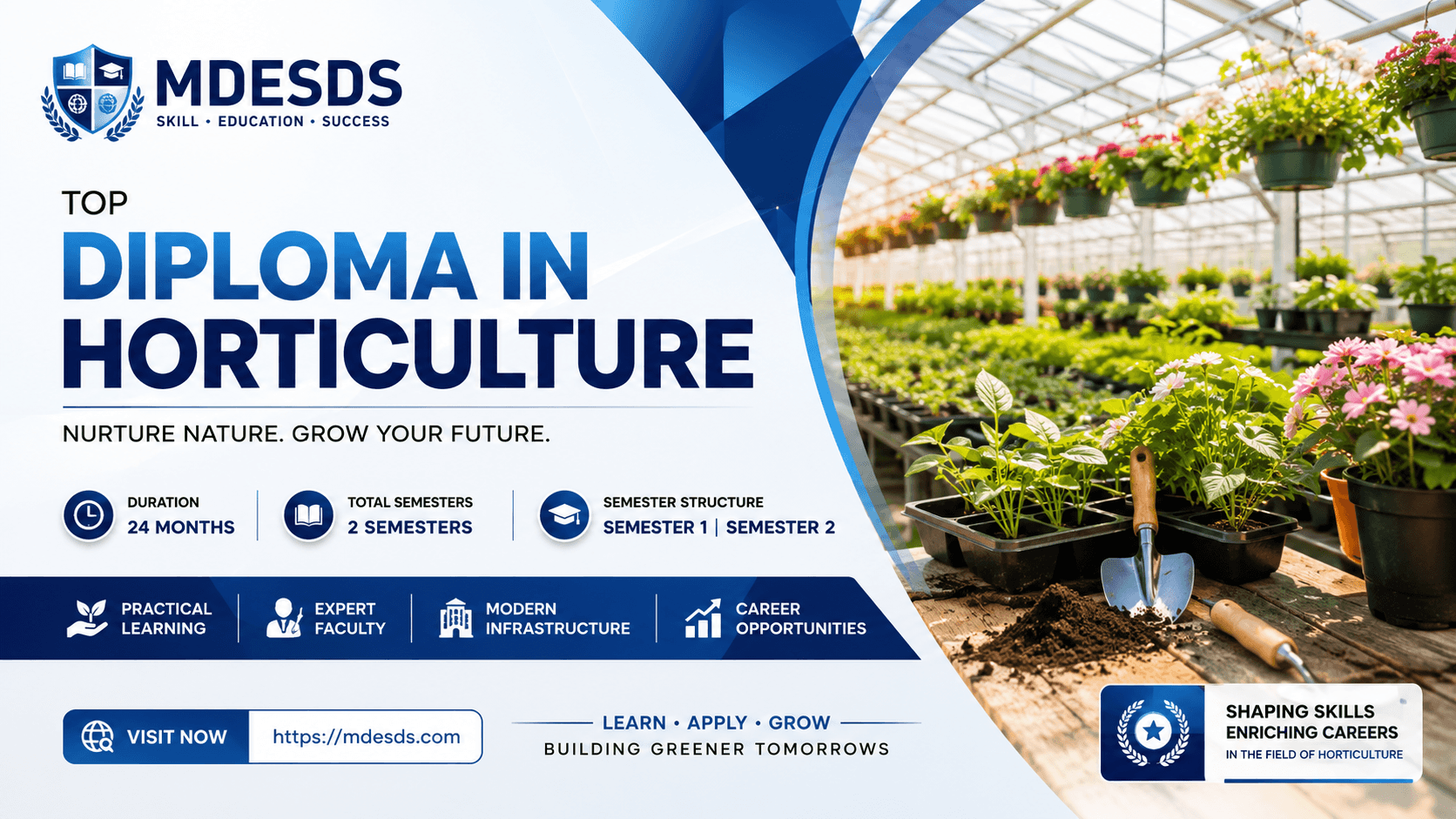
At MDESDS, our program runs for a total course duration of 24 months, split across two intensive semesters. To accommodate both working professionals and full-time students, we deliver this program via a flexible hybrid learning mode. This means you get the best of both worlds: convenient online theoretical lectures combined with essential, hands-on practical training in real-world nurseries and laboratory environments. Over the 24-month period, students dive deep into plant physiology, soil health, breeding techniques, and modern climate-smart agricultural practices.
Our curriculum is curated by industry experts and academic professionals to ensure it aligns with current market demands. The program is systematically structured into two comprehensive semesters over its 24-month duration, offering an optimal balance of theory and field-based application.
The first semester focuses on building a rock-solid foundation in horticultural principles, weather patterns, and plant biology. Students learn how plants grow, react to environmental factors, and maintain internal health.
Primer On Horticulture
What you will learn: An introduction to the classification, tools, zones, and fundamental cultivation systems used in modern horticulture.
Practical Benefits: You will master the basics of soil preparation, bed layout, and essential tool handling, allowing you to manage garden layouts effectively from day one.
Skills Gained: Crop categorization, soil analysis, basic pruning, and layout designing.
Introductory Crop Physiology & Crop Physiology
What you will learn: These core modules cover the internal life processes of plants, including photosynthesis, respiration, transpiration, and nutrient absorption.
Practical Benefits: Understanding how a plant functions internally allows you to diagnose growth deficiencies, optimize fertilizer applications, and maximize yield.
Skills Gained: Nutrient deficiency diagnosis, metabolic tracking, and growth regulation application.
Agro-Meteorology And Climate Change
What you will learn: A critical study of weather parameters, microclimates, and how shifting global climate patterns affect crop cycles.
Practical Benefits: You will learn how to read meteorological data to predict frost, droughts, or heatwaves, allowing you to implement protective shielding or alter irrigation schedules to save crops.
Skills Gained: Weather data interpretation, microclimate management, and climate-resilient crop planning.
Information And Communication Technology (ICT)
What you will learn: The integration of digital tools, smart farming software, GIS mapping, and data analytics into daily agricultural management.
Practical Benefits: Modern farming relies heavily on data. This subject ensures you can confidently operate automated greenhouse systems, use drone imagery data, and manage farm inventory digitally.
Skills Gained: Smart-farm software navigation, digital inventory tracking, and data-driven yield forecasting.
The second semester shifts towards commercialization, advanced breeding techniques, and protecting high-value crops from economic damage.
Commercial Floriculture
What you will learn: Capitalizing on the multi-billion-dollar flower industry, this module covers the commercial cultivation of cut flowers, loose flowers, and ornamental landscaping plants.
Practical Benefits: You will learn the exact greenhouse parameters required to grow premium roses, lilies, and marigolds for international export and local event decor markets.
Skills Gained: Greenhouse flower management, post-harvest packaging, and floral crop scheduling.
Nursery Technology Of Horticultural Crops
What you will learn: The science behind plant propagation techniques like grafting, layering, budding, and tissue culture, alongside commercial nursery setup management.
Practical Benefits: Instead of growing plants from seeds, you will master cloning high-yield varieties, allowing you to run or work in professional plant nurseries producing thousands of uniform plants.
Skills Gained: Advanced grafting/budding, media preparation, rootstock selection, and nursery inventory control.
Commercial Tropical Vegetable Culture
What you will learn: Production technologies for major tropical vegetables, including solanaceous crops, cucurbits, and root vegetables.
Practical Benefits: You will gain the skills to run large-scale vegetable farms, focusing on maximizing harvest per square meter while utilizing sustainable irrigation.
Skills Gained: High-density vegetable planting, drip-irrigation management, and commercial harvest timing.
Fundamentals Of Plant Pathology
What you will learn: An in-depth study of plant diseases caused by fungi, bacteria, viruses, and nematodes, alongside integrated pest management (IPM).
Practical Benefits: You will be able to spot early signs of crop infection before it spreads, applying targeted, eco-friendly treatments that save whole harvests without ruining soil health.
Skills Gained: Disease identification, microscopic pathogen analysis, and biopesticide formulation.
Principles Of Plant Breeding
What you will learn: The genetics and methods used to select, cross, and breed plants to create varieties that are more pest-resistant, drought-tolerant, and high-yielding.
Practical Benefits: This knowledge allows you to work in seed production companies, helping develop the next generation of resilient food crops.
Skills Gained: Hybridization techniques, pollen collection, and genetic selection field plotting.
The MDESDS Diploma In Horticulture is highly versatile, appealing to a broad range of career goals. This program is an ideal fit for:
Aspiring Entrepreneurs: Individuals looking to start their own commercial plant nursery, organic vegetable farm, floriculture export house, or landscaping consultancy.
Agriculture Professionals: Existing farmers or agricultural workers who want to upgrade their skills with scientific, modern methods to shift into high-profit horticultural crops.
Students and Lifelong Learners: Anyone who has completed their basic higher secondary education and wants a practical, job-oriented career path in environmental science.
Nature Enthusiasts & Career Changers: Professionals currently stuck in desk jobs who want to transition to a fulfilling, green career that combines outdoor management with scientific strategy.
Investing 24 months in this hybrid diploma program provides unique personal and professional advantages:
High Profit Potential: Horticulture focuses on high-value cash crops (like exotic flowers and off-season vegetables) that command much higher market prices than traditional field grains.
Flexible Hybrid Learning: Our unique instructional setup allows you to balance your studies with existing personal or professional commitments, moving seamlessly between digital classrooms and physical labs.
Future-Proof Skillset: As climate change complicates open-field farming, experts who understand greenhouse tech, plant pathology, and microclimates are in urgent demand globally.
Hands-on Scientific Expertise: You won’t just read about plants; you will learn how to alter their genetics, heal their diseases, and manipulate their environment for optimal growth.
Graduating with a Diploma In Horticulture opens up diverse employment doors across both the public and private sectors. The scope of this field is expanding rapidly as corporate real estate, luxury hospitality, and urban planning firms place heavy emphasis on green building certifications and eco-landscaping.
Some of the most popular career paths include:
Horticultural Consultant / Landscaping Specialist: Design, execute, and maintain green belts, vertical gardens, and lawns for corporate parks, luxury resorts, and residential complexes.
Nursery Manager: Oversee the commercial production of ornamental, fruit, and timber saplings, managing everything from automated propagation to B2B sales.
Plant Protection Specialist: Work with agro-chemical or organic fertilizer companies to help farmers diagnose crop diseases and implement integrated pest management systems.
Floriculture Production Supervisor: Manage commercial greenhouses dedicated to high-density flower cultivation for domestic florists and international export markets.
Agricultural Officer / Field Inspector: Work alongside regional agricultural bodies, cooperatives, or NGOs to promote sustainable farming practices among rural communities.
When it comes to pursuing professional agricultural education, the institution you choose matters immensely. MDESDS stands out as a premier destination for holistic development.
Industry-Aligned Faculty: Learn from certified agronomists, plant biologists, and seasoned commercial horticulturists who bring real field experience into the classroom.
State-of-the-Art Hybrid Infrastructure: Our digital learning management system makes grasping complex theoretical concepts intuitive, while our partnered field facilities provide raw, uncompromised practical experience.
Comprehensive Student Support: From regular skill-gap evaluations to resume building and placement assistance, we ensure our students are entirely job-ready by the time their 24 months are complete.
Focus on Sustainability: At MDESDS, we don't just teach high-yield production; we focus heavily on environmental conservation, teaching you how to grow responsibly using resource-efficient practices.
Don't wait to turn your passion for plants into a fulfilling, professional career. Admissions for our upcoming batch are currently open. Equip yourself with the scientific edge, practical skills, and recognized certification needed to lead the sustainable agricultural movement.
The Diploma In Horticulture course is designed to provide practical knowledge, professional skills, and industry-relevant training. With a duration of 24 Months, this program helps students develop the expertise required for academic and professional success.

Kickstart your career with our 12-month hybrid Diploma In Civil Engineering. Gain industry-ready skills with MDESDS. Enr...

Gain essential IT skills with MDESDS. Enroll in our 3-month hybrid Certificate In Computer Application course for career...

Unlock top career opportunities with our 6-month Diploma Course In Stenography at MDESDS. Master shorthand, typing, and ...
Join MDESDS and build a successful future with industry-recognized diploma, certificate, vocational, and professional training programs. Limited seats available for the current academic session. Apply today and take the next step toward your career goals.