Applications are now open for the Academic Session 2026-27.
Open
Applications are now open for the Academic Session 2026-27.
Applications are now open for the Academic Session 2026-27.
Applications are now open for the Academic Session 2026-27.

Advance your green career with MDESDS. Discover a 12-month hybrid Diploma In Horticulture, blending core plant science with rich hands-on commercial skills.

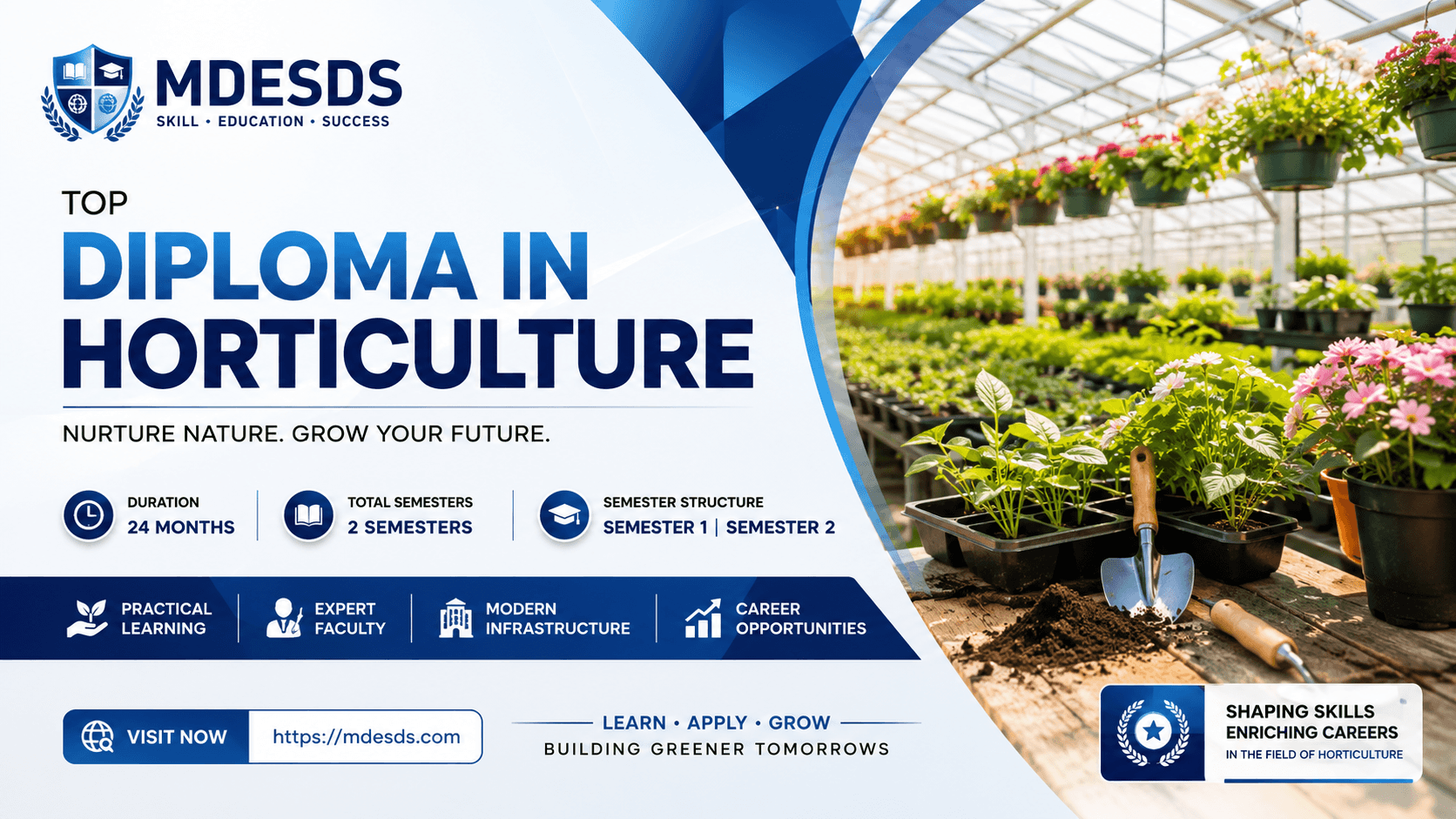
The global demand for sustainable agriculture, urban green spaces, and organic food production is growing at an unprecedented rate. As cities expand and environmental awareness rises, the need for qualified professionals who understand the intricate balance of plant science and commercial cultivation has never been higher. If you have a passion for plants, landscaping, or agricultural entrepreneurship, turning that passion into a structured career requires formalized, expert training.
The Diploma In Horticulture offered by MDESDS is designed to bridge the gap between traditional gardening practices and modern, technology-driven agricultural science. This comprehensive professional program equips you with the technical skills, business acumen, and scientific foundation needed to thrive in the modern green economy. Through a meticulously planned curriculum, students learn how to maximize crop yields, manage commercial nurseries, design stunning landscapes, and implement sustainable farming practices that protect our ecosystem.
A Diploma In Horticulture is a specialized academic and practical program focused on the science, art, technology, and business of intensive plant cultivation. Unlike general agricultural studies, horticulture specifically zeroes in on high-value crops, including fruits, vegetables, aromatic plants, and ornamental flowers.
At MDESDS, this curriculum is engineered to transform enthusiasts into industry-ready professionals. The program covers everything from the foundational biological processes of plants to advanced market-driven cultivation techniques. By blending scientific theory with practical application, the Diploma In Horticulture ensures that graduates do not just know how a plant grows, but also how to scale production, manage diseases, and build a profitable venture in the agricultural or landscaping sectors.
The Diploma In Horticulture at MDESDS is a comprehensive 12-month program structured across an intensive learning journey. To accommodate both working professionals and full-time students, the program is delivered via a flexible hybrid learning mode. This hybrid structure seamlessly blends interactive online theory sessions with critical, hands-on practical training and field visits, ensuring you gain deep theoretical insights without sacrificing vital real-world exposure.
The curriculum is focused on deep, specialized expertise. Below is a detailed analysis of the core subjects you will master during this 12-month journey, along with the specific skills and practical benefits each module provides.
The first phase of the program focuses on building an unshakeable scientific foundation while introducing students to high-value commercial sectors within horticulture.
Subject Overview: This foundational module introduces students to the global horticultural landscape, basic plant anatomy, classification, and environmental factors influencing growth. You will explore soil health, nutrition, climate zones, and basic propagation methods.
Practical Benefits: Understanding this primer prevents costly trial-and-error mistakes in the field. It allows you to analyze soil quality, choose the right crop for specific climatic conditions, and optimize growing environments for maximum plant health.
Skills Gained: Soil testing and amendment, crop selection mapping, climate risk assessment, and basic plant identification.
Subject Overview: Flowers are among the most profitable commodities in agriculture. This subject covers the commercial production of major cut flowers (like roses, carnations, and gerberas) and loose flowers (like marigolds and jasmine), focusing on both open-field and greenhouse cultivation.
Practical Benefits: You will learn how to target lucrative festive and export markets. This module teaches you how to control blooming schedules, handle delicate harvests, and implement post-harvest technologies to minimize losses during transport.
Skills Gained: Greenhouse climate control, flower grading and packaging, shelf-life extension techniques, and seasonal crop planning.
Subject Overview: This subject dives deep into the inner workings of plants. Students study vital processes such as photosynthesis, respiration, transpiration, and how plants respond to stress factors like drought, salinity, or extreme heat.
Practical Benefits: By understanding plant behavior at a cellular level, you can accurately diagnose deficiencies and health issues before visual symptoms damage the crop. This scientific insight directly translates to smarter watering, feeding, and pruning schedules.
Skills Gained: Plant stress diagnosis, nutrient deficiency mapping, growth regulator (hormone) application, and metabolic optimization.
Subject Overview: Every successful harvest begins with a high-quality sapling or seed. This module covers nursery management, including advanced propagation techniques (grafting, layering, budding), growing media preparation, and automated nursery infrastructure.
Practical Benefits: Setting up a nursery requires precise technical knowledge. This subject teaches you how to mass-produce healthy, disease-free planting material, which can serve as a highly profitable standalone business or cut input costs for your own farm.
Skills Gained: High-success grafting and budding, automated mist-chamber management, media sterilization, and nursery business licensing workflows.
Subject Overview: Vegetables are essential to daily nutrition, presenting a continuous market demand. This subject focuses on the intensive cultivation of tropical vegetables, including solanaceous crops (tomatoes, peppers), cucurbits, and root vegetables.
Practical Benefits: You will master the art of high-density planting and off-season vegetable production. This knowledge enables you to supply markets when prices are at their peak, ensuring a steady, profitable return on investment.
Skills Gained: Drip irrigation setup, plastic mulching techniques, integrated pest management (IPM), and off-season crop forcing.
The Diploma In Horticulture is highly versatile, welcoming learners from diverse backgrounds. This program is an ideal fit for:
Aspiring Entrepreneurs: Individuals looking to start their own commercial nurseries, organic farms, floriculture exports, or landscaping businesses.
Agricultural Professionals: Existing farmers or farm managers who want to transition from low-margin traditional crops to high-value horticultural commodities.
Landscapers and Architects: Professionals in urban planning or real estate who want a formal understanding of plant science to create sustainable green spaces.
Nature Enthusiasts & Career Changers: Anyone seeking to turn a love for nature into a structured, profitable, and meaningful professional career.
Choosing to study horticulture provides a clear path to professional growth. Here is what makes this program highly valuable:
High Profit Potential: Horticulture deals with high-value crops. Learning how to manage these effectively opens doors to lucrative agricultural sectors.
Flexible Hybrid Learning: The 12-month program uses a hybrid mode, allowing you to study core theoretical concepts at your own pace online while attending crucial in-person practical sessions.
Sustainability Focus: You will master eco-friendly pest management, water conservation techniques, and organic practices that are highly sought after by modern corporate farms.
Scientific and Practical Balance: MDESDS ensures you don't just study books; you practice grafting, manage greenhouses, and handle real soil analysis.
Completing a Diploma In Horticulture opens doors across a wide range of job markets and industrial sectors.
Horticulturist / Farm Supervisor: Overeeing production operations in corporate orchards, vegetable farms, or commercial greenhouses.
Nursery Manager: Managing production, quality control, and sales of young plants and saplings in private or government nurseries.
Landscape Designer / Consultant: Creating and maintaining urban green walls, residential gardens, corporate parks, and golf courses.
Plant Protection Specialist: Advising farms on integrated pest management, disease control, and biological remedies.
Horticulture Entrepreneur: Launching your own business in mushroom farming, organic vegetable delivery, floriculture, or boutique nursery management.
The scope of horticulture is expanding rapidly. With the rise of smart cities, vertical farming, hydro-culture, and rooftop gardening, urban areas are demanding horticultural expertise. Furthermore, corporate social responsibility (CSR) initiatives frequently focus on environmental restoration, creating consistent demand for environmental consultants and green space managers.
When it comes to agricultural and professional education, MDESDS stands out as a symbol of trust, quality, and student-focused learning.
Expert Faculty: Learn from experienced agricultural scientists, seasoned agronomists, and successful green entrepreneurs who bring real-world case studies into the classroom.
Industry-Aligned Curriculum: Our syllabus is updated frequently to reflect current market trends, matching what employers and the industry need right now.
State-of-the-Art Infrastructure: Gain exposure to modern agricultural tools, soil testing labs, and high-tech greenhouse setups during practical training modules.
Robust Placement Support: We don't just teach; we help build careers. MDESDS provides resume workshops, interview preparation, and placement assistance with leading agribusiness firms and landscaping companies.
Don't leave your passion for plant science as just a hobby. Turn it into a rewarding, future-proof career with a professional qualification that carries real weight in the modern agricultural industry. Enroll in the Diploma In Horticulture at MDESDS today and start mastering the future of sustainable, high-value farming.
The Diploma In Horticulture course is designed to provide practical knowledge, professional skills, and industry-relevant training. With a duration of 12, this program helps students develop the expertise required for academic and professional success.

Advance your career with our 12-month Diploma In Fitter at MDESDS. Master precision engineering through expert-led hybri...
Gain vital medical skills with our 12-month hybrid Diploma In Community Health Care at MDESDS. Start your rewarding heal...

Gain professional cleaning expertise with our Certificate In Sweeper course at MDESDS. Master advanced equipment in this...