Applications are now open for the Academic Session 2026-27.
Open
Applications are now open for the Academic Session 2026-27.
Applications are now open for the Academic Session 2026-27.
Applications are now open for the Academic Session 2026-27.

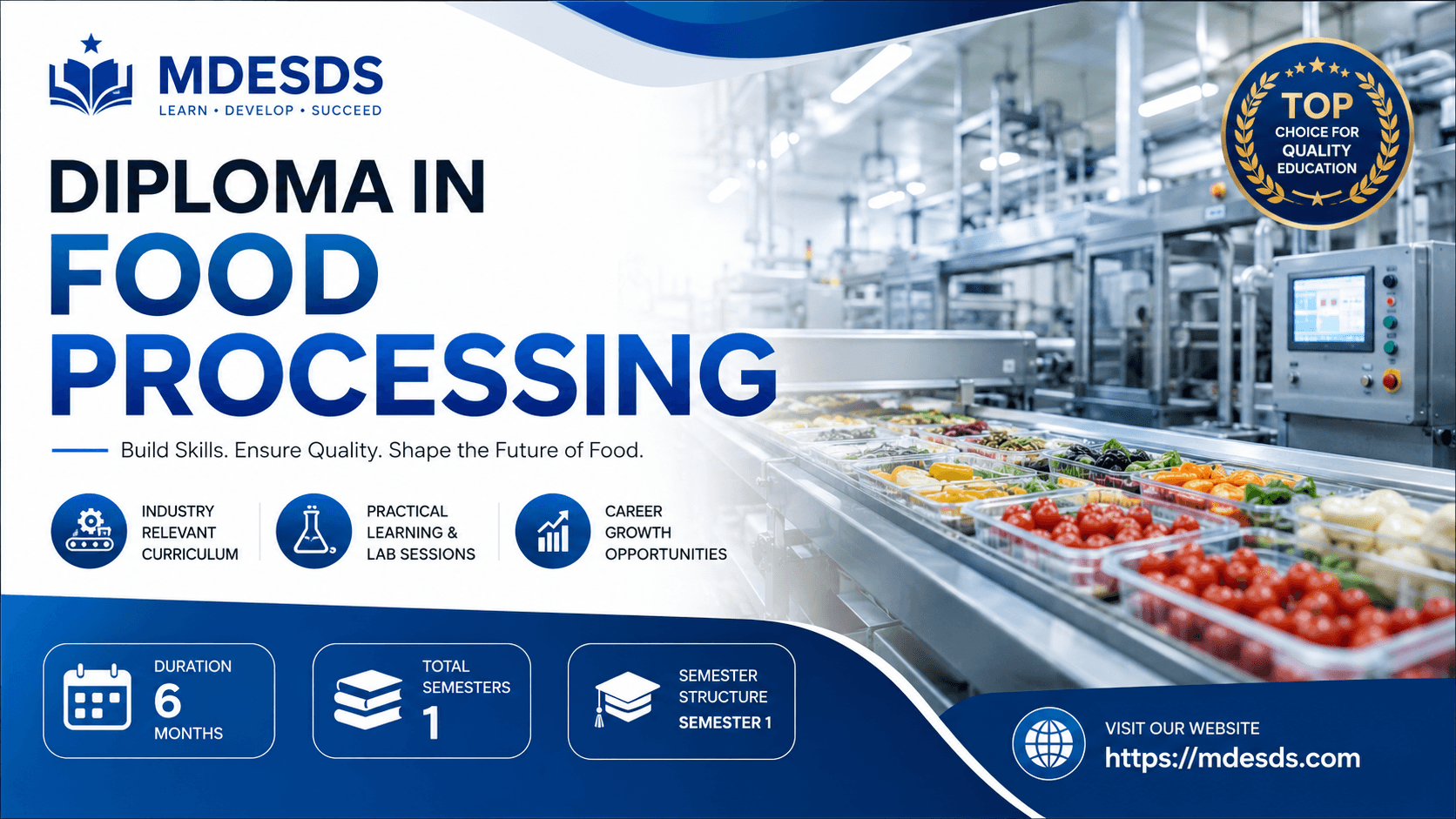
Master culinary skills, bakery, and hygiene with our 12-month hybrid Diploma In Food Processing at MDESDS. Start your global food industry career today.
The global food industry is expanding at an unprecedented pace. With shifting consumer preferences, a rising demand for packaged and ready-to-eat meals, and a massive focus on food safety, the need for trained professionals in food manufacturing and culinary arts has never been higher.
If you have a passion for food, science, and creativity, stepping into this sector can open doors to a highly rewarding global career. The Diploma In Food Processing offered by MDESDS is a meticulously designed program that bridges the gap between traditional culinary skills and modern food preservation techniques. This course is engineered to transform passionate food enthusiasts into industry-ready professionals who understand food from the farm to the fork.
A Diploma In Food Processing is a specialized professional program that focuses on the techniques, sciences, and methodologies involved in transforming raw agricultural ingredients into consumable, marketable food products. It combines the art of advanced cookery and bakery with the science of food safety, hygiene, costing, and equipment maintenance.
At MDESDS, this program is delivered via a flexible hybrid learning mode, allowing students to balance theoretical insights through online resources while gaining intensive, hands-on experience through practical lab sessions. Spanning a comprehensive duration of 12 months, the program ensures that you don't just learn the recipes, but you also master the core mechanics of commercial food production, cost optimization, and large-scale kitchen operations.
The Diploma In Food Processing at MDESDS is structured as a robust 12-month program. It condenses extensive practical training and crucial industry theories into a well-paced academic year divided into a focused semester system.
The primary semester lays down the foundational stone for both classical cooking and industrial food operations. Below is the detailed breakdown of the subjects you will master, along with the practical benefits and skills you will acquire.
What you will learn: This subject introduces you to the foundational principles of professional cooking, food commodities, and cold kitchen (larder) management. The practical sessions focus on knife skills, mastering mother sauces, stock preparation, and understanding cooking methods like braising, roasting, and poaching.
Practical Benefits: You will gain the confidence to handle commercial kitchen environments, understand food chemistry during cooking, and learn how to manage bulk food preparation without compromising quality.
Skills Gained: Precision knife handling, flavor balancing, menu execution, and raw ingredient optimization.
What you will learn: Here, the focus shifts to the cold kitchen station (larder), covering charcuterie, salads, dressings, and cold appetizers. Simultaneously, the theory aspect introduces you to the science of baking, understanding the behavior of yeast, gluten development, and the functions of sugars and fats.
Practical Benefits: You learn the art of presentation and preservation of cold foods, which is essential for buffets and high-end catering. The baking theory ensures you understand why a pastry rises or falls, reducing wastage in commercial production.
Skills Gained: Food styling, cold preservation, dough formulation, and structural baking science.
What you will learn: This hands-on subject gets you working with ovens and proofers to create breads, cakes, tarts, and pastries. Parallelly, the hygiene module teaches you about foodborne illnesses, cross-contamination, personal grooming, and international kitchen safety standards (like HACCP).
Practical Benefits: You will be able to set up a commercial bakery line and ensure that every item produced meets strict food safety laws, minimizing risk for food businesses.
Skills Gained: Commercial baking techniques, pastry decoration, sanitization protocols, and food safety compliance.
What you will learn: Industrial kitchens rely on heavy machinery—from industrial mixers and walk-in freezers to commercial food processors. This module teaches the operation, safety guidelines, and routine maintenance of these machines, coupled with advanced larder theories.
Practical Benefits: Knowing how to maintain equipment prevents costly kitchen downtimes and ensures operational safety, making you an incredibly valuable asset to any production plant or hotel.
Skills Gained: Technical troubleshooting, preventative maintenance, industrial safety management, and advanced culinary planning.
What you will learn: A great chef or food processor must also be a good businessman. This module covers food cost percentage, portion control, yield management, and menu pricing. Additionally, you will dive into the rich heritage of Indian cuisine, mastering spices, gravies, and regional culinary techniques.
Practical Benefits: You will learn how to run a kitchen profitably by eliminating waste and pricing items correctly. The Indian cooking segment ensures you have a strong grip on one of the world's most popular commercial cuisines.
Skills Gained: Financial budgeting, portion control, recipe costing, spice blending, and authentic regional Indian cooking.
The Diploma In Food Processing is ideal for a diverse group of aspirants:
Aspiring Chefs & Bakers: Individuals who want to turn their passion for cooking into a structured, highly paid professional career.
Food Entrepreneurs: Anyone planning to launch their own cloud kitchen, bakery, catering business, or packaged food brand.
Hotel Management Professionals: Individuals looking to add specialized technical skills in food production to their resumes.
Career Switchers: Professionals from other fields looking for a rapid, 12-month pathway into the booming hospitality and food manufacturing sector.
Choosing where to study is just as crucial as choosing what to study. Here is what makes our Diploma In Food Processing stand out:
Flexible Hybrid Learning: Our unique hybrid learning mode allows you to balance theoretical study at your own pace while dedicating focused time to intensive in-person practicals.
Fast-Track 12-Month Duration: Get job-ready in just one year without spending years on long-drawn degree programs.
Industry-Aligned Curriculum: Our syllabus focuses purely on what employers want—practical cooking, strict hygiene, costing, and technical maintenance skills.
Experienced Faculty: Learn from seasoned culinary experts and food technologists who bring decades of real-world kitchen and factory experience to the classroom.
The food industry is highly resilient to economic downturns—because people will always need to eat. Completing your Diploma In Food Processing unlocks a variety of career paths across hotels, cruise ships, airlines, food manufacturing units, and retail chains.
Food Processing Technician: Overseeing production lines in food and beverage manufacturing companies.
Commis Chef / Demi Chef de Partie: Working in stars hotels, fine dining restaurants, and resorts across hot or cold kitchen stations.
Production Supervisor: Managing workflow, safety, and output in commercial bakery units or centralized cloud kitchens.
Food Quality Inspector: Ensuring that food manufacturing units strictly adhere to health, safety, and hygiene standards.
Catering Manager: Planning, costing, and executing large-scale food production for corporate events, airlines, or institutions.
The scope of food processing is reaching global heights. With the rise of food tech platforms, sustainable plant-based alternatives, and global export markets, professionals trained in commercial food handling, costing, and safety are highly sought after both in India and abroad.
MDESDS is committed to delivering vocational and professional education that translates directly into employment. Our Diploma In Food Processing is designed with an emphasis on rigorous practical exposure. We understand that food processing cannot be learned purely from textbooks.
By providing a modern hybrid learning environment, state-of-the-art kitchen labs, and deep industry connections, MDESDS ensures that every student graduates with the confidence, technical skills, and business acumen required to excel from day one.
Are you ready to transform your love for food into a professional, globally recognized career? Don't wait to build your future. Secure your seat in the upcoming batch of our Diploma In Food Processing.
The Diploma In Food Processing course is designed to provide practical knowledge, professional skills, and industry-relevant training. With a duration of 12, this program helps students develop the expertise required for academic and professional success.
Advance your healthcare career with MDESDS's 12-month hybrid Diploma In Medical Assistant. Gain practical patient care s...
Launch your tech career with MDESDS's 12-month hybrid Diploma In Information Technology. Gain practical skills in C prog...
Kickstart your career with our 12-month hybrid Diploma In Civil Engineering. Gain industry-ready skills with MDESDS. Enr...