Applications are now open for the Academic Session 2026-27.
Open
Applications are now open for the Academic Session 2026-27.
Applications are now open for the Academic Session 2026-27.
Applications are now open for the Academic Session 2026-27.

Gain critical hazard management skills with MDESDS's 24-month Diploma In Fire Safety. Explore hybrid modules, top career paths, and legal standards.
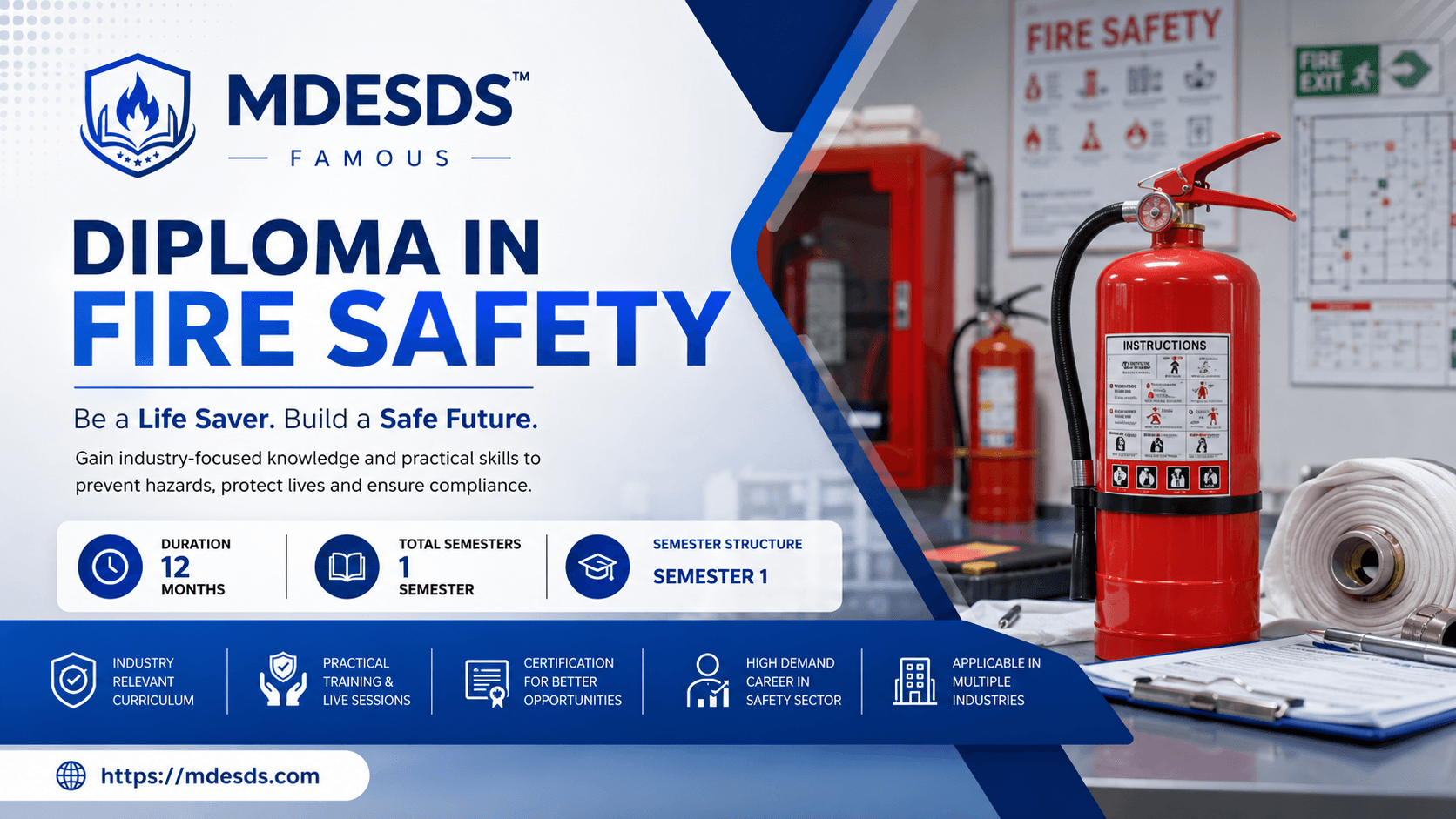
Fire accidents and industrial hazards can strike without warning, resulting in devastating losses of life, property, and organizational reputation. As businesses, manufacturing units, and high-rise infrastructures expand globally, the demand for trained professionals who can prevent, manage, and mitigate these risks has skyrocketed. A career in fire and safety is no longer just about emergency response; it is a critical pillar of modern corporate governance and public safety.
The Diploma In Fire Safety offered by MDESDS is a meticulously structured program designed to transform aspiring candidates into highly skilled safety professionals. This course bridges the gap between theoretical safety protocols and real-world emergency management, ensuring that industries remain compliant, secure, and prepared for any crisis. By enrolling in this program, you choose a career path dedicated to protecting lives while securing a stable, highly rewarding professional future.
The Diploma In Fire Safety is a comprehensive professional program focused on the science of fire prevention, hazard identification, emergency rescue operations, and industrial safety compliance. This specialized curriculum equips students with a deep understanding of how fires start, spread, and can be safely extinguished or contained.
At MDESDS, this program is delivered via a flexible hybrid learning mode, combining the convenience of online theoretical classes with rigorous, hands-on practical training sessions. Spanning a comprehensive duration of 24 months, the course splits its advanced curriculum across two distinct semesters. Students don't just learn the theory behind fire dynamics; they master the practical deployment of fire combat equipment, understand the psychology of crowd control during crises, and study the legal frameworks governing industrial safety standards.
To ensure our students are fully prepared for the workplace, MDESDS offers a strategically divided curriculum. The 24-month duration allows for a deep dive into both foundational and advanced safety principles.
Here is the detailed, semester-wise breakdown of the subjects you will master during this course, along with the practical benefits and skills you will acquire from each module.
The first half of this 24-month program focuses on building a rock-solid foundation in industrial environments, understanding the core elements of fire, and learning how to handle essential safety apparatus.
Industrial Safety Management
Practical Benefits: Learn how to conduct thorough workplace risk assessments, identify potential mechanical or environmental hazards, and implement zero-accident policies in heavy industries.
Skills Gained: Hazard identification, safety auditing, risk mitigation planning, and implementation of accident-prevention protocols.
Electrical & Chemical Fire Safety
Practical Benefits: Electrical malfunctions and chemical spills are among the leading causes of devastating industrial fires. This subject teaches you how to handle specialized hazardous materials (HAZMAT) and control complex electrical fires safely without exacerbating the danger.
Skills Gained: Understanding chemical reactivity charts, isolation of electrical grids, specialized extinguishing agent selection, and safe handling of hazardous substances.
Fire Prevention & Protection
Practical Benefits: The best way to handle a fire is to prevent it from happening. You will learn to design building layouts that incorporate passive fire protection systems, such as fire-resistant doors, walls, and proper ventilation escapes.
Skills Gained: Blueprint reading for safety compliance, structural fire barrier evaluation, and design of safe evacuation routes.
Fire Safety Equipment
Practical Benefits: Direct, hands-on familiarity with the tools of the trade. Students learn how to inspect, maintain, and operate different types of fire extinguishers, hoses, nozzles, hydrants, and personal protective equipment (PPE).
Skills Gained: Equipment troubleshooting, calibration of safety gear, swift deployment of fire hoses, and maintenance of breathing apparatus.
Fire Detection & Alarm System
Practical Benefits: Early detection saves thousands of lives. This module teaches you how automated smoke detectors, heat sensors, and sprinkler systems function, ensuring you can manage a building's central control safety room.
Skills Gained: Programming and monitoring fire alarm panels, testing sensor sensitivity, and integrating building management systems with emergency alarms.
The second semester shifts focus toward active field operations, lifesaving medical responses, legislative compliance, and real-world application through dedicated project work.
Fire Fighting Techniques & Operations
Practical Benefits: Train for real-life combat against aggressive blazes. You will study fire behavior, ventilation tactics, and how to coordinate multi-person teams to suppress fires efficiently in confined spaces or high-rise structures.
Skills Gained: Incident command leadership, structural firefighting tactics, offensive and defensive hose layouts, and smoke ventilation management.
First Aid & Emergency Medical Response
Practical Benefits: Fire fighters are often the first medical responders on a scene. This subject provides intensive training on treating burns, smoke inhalation injuries, fractures, and performing lifesaving CPR before secondary medical help arrives.
Skills Gained: Cardiopulmonary Resuscitation (CPR), trauma care management, triage during mass casualty events, and basic life support (BLS).
Rescue Operations
Practical Benefits: Learn the specialized physical and technical skills required to rescue individuals trapped in collapsed buildings, deep trenches, elevators, or high-rise structures during a crisis.
Skills Gained: Knot tying and rope rescue systems, casualty extraction techniques, search-and-rescue patterns, and usage of hydraulic cutting tools.
Fire Safety Laws, Acts & Standards
Practical Benefits: Organizations must comply with strict legal mandates to avoid heavy penalties and closure. This subject ensures you are thoroughly versed in national building codes, factories acts, and international safety standards (like NFPA or OSHA).
Skills Gained: Legal compliance auditing, drafting safety policy documentation, and navigating statutory safety inspections.
Project Work
Practical Benefits: The capstone of your Diploma In Fire Safety. Students undertake an intensive, real-world case study or safety audit under the guidance of industry experts, consolidating all their learning into a practical blueprint.
Skills Gained: Technical report writing, data analysis, project management, and presenting safety solutions to corporate stakeholders.
The Diploma In Fire Safety is an inclusive yet highly specialized program open to a diverse range of candidates:
Fresh Graduates & 10+2 Passouts: Individuals looking to enter a recession-proof, noble profession with high career growth straight after school or college.
Working Safety Professionals: Existing safety wardens, security supervisors, or industrial workers who wish to formalize their experience with an accredited diploma to climb the corporate ladder.
Engineers and Technical Diploma Holders: Civil, mechanical, or electrical engineers who want to add a powerful niche specialization to their profiles, making them highly attractive to top-tier construction and manufacturing firms.
Defense & Ex-Servicemen: Individuals from military or paramilitary backgrounds seeking a smooth transition into lucrative corporate safety and security roles.
Investing your time in this 24-month program opens up a world of professional stability and personal fulfillment.
High Global Demand: Every country enforces strict occupational health and safety laws. A qualification in fire safety makes you globally employable.
Blended Flexibility: The hybrid learning mode ensures that you do not have to disrupt your current job or personal commitments to gain a premium education.
Recession-Proof Career: Safety is not optional. Whether an economy is booming or facing a downturn, industries must maintain safety compliance, ensuring your job remains secure.
High Earning Potential: As you transition from entry-level officer roles to managerial positions, the financial compensation packages grow substantially, often including excellent corporate perks.
Completing your Diploma In Fire Safety from MDESDS unlocks diverse employment opportunities across multiple booming sectors. Every major infrastructure project, refinery, airport, and commercial complex requires dedicated safety personnel.
Fire Safety Officer: Responsible for implementing safety routines, conducting regular drills, and maintaining fire fighting equipment across a corporate facility.
Safety Auditor / Consultant: An expert role working with third-party agencies to inspect factories, commercial buildings, and warehouses to check compliance with national safety laws.
HSE (Health, Safety, and Environment) Officer: A holistic corporate role managing environmental impacts, workplace health protocols, and fire safety systems simultaneously.
Fire Station Officer / Marshal: Leading emergency response teams during active fire containment and rescue operations.
Risk Assessment Manager: Analyzing complex blueprints and operational workflows to predict hazards and design mitigation strategies before construction or production begins.
Oil & Gas Refineries
Chemical and Pharmaceutical Manufacturing Plants
High-Rise Residential & Commercial Real Estate Projects
Airports, Seaports, and Metro Rail Networks
Automobile and Heavy Engineering Sectors
Government Fire Services and Municipal Corporations
MDESDS stands out as a premier institution dedicated to cultivating top-tier safety professionals. Our approach to training balances academic excellence with deep practical exposure.
Expert Faculty: Learn from seasoned fire marshals, industrial safety consultants, and legal experts who bring real-world crisis scenarios into the classroom.
State-of-the-Art Hybrid Infrastructure: Our digital learning management system provides seamless access to theoretical lectures, while our physical workshop tie-ups give you hands-on experience with real fire fighting drills.
Industry-Aligned Curriculum: We regularly update our modules to reflect the newest technological advancements in smart alarm systems, modern extinguishing agents, and evolving global safety statutes.
Robust Placement Support: MDESDS values your career ambitions. We provide comprehensive resume building, interview preparation, and placement assistance to connect our graduates with leading global employers.
Don't wait to build a career that saves lives and secures industries. Join the Diploma In Fire Safety program at MDESDS today and become a certified asset to the global workforce.
The Diploma In Fire Safety course is designed to provide practical knowledge, professional skills, and industry-relevant training. With a duration of 24 Months, this program helps students develop the expertise required for academic and professional success.

Master finance with MDESDS's 6-month Diploma In Accounting And Taxation. Gain practical skills in Tally, taxation, and b...

Kickstart your medical career with our Certificate In X-ray Technology. Gain hands-on skills in radiography through a 12...

Enroll in MDESDS’s comprehensive 24-month Pre Primary Teacher Training to master early childhood education through our h...
Join MDESDS and build a successful future with industry-recognized diploma, certificate, vocational, and professional training programs. Limited seats available for the current academic session. Apply today and take the next step toward your career goals.