Applications are now open for the Academic Session 2026-27.
Open
Applications are now open for the Academic Session 2026-27.
Applications are now open for the Academic Session 2026-27.
Applications are now open for the Academic Session 2026-27.

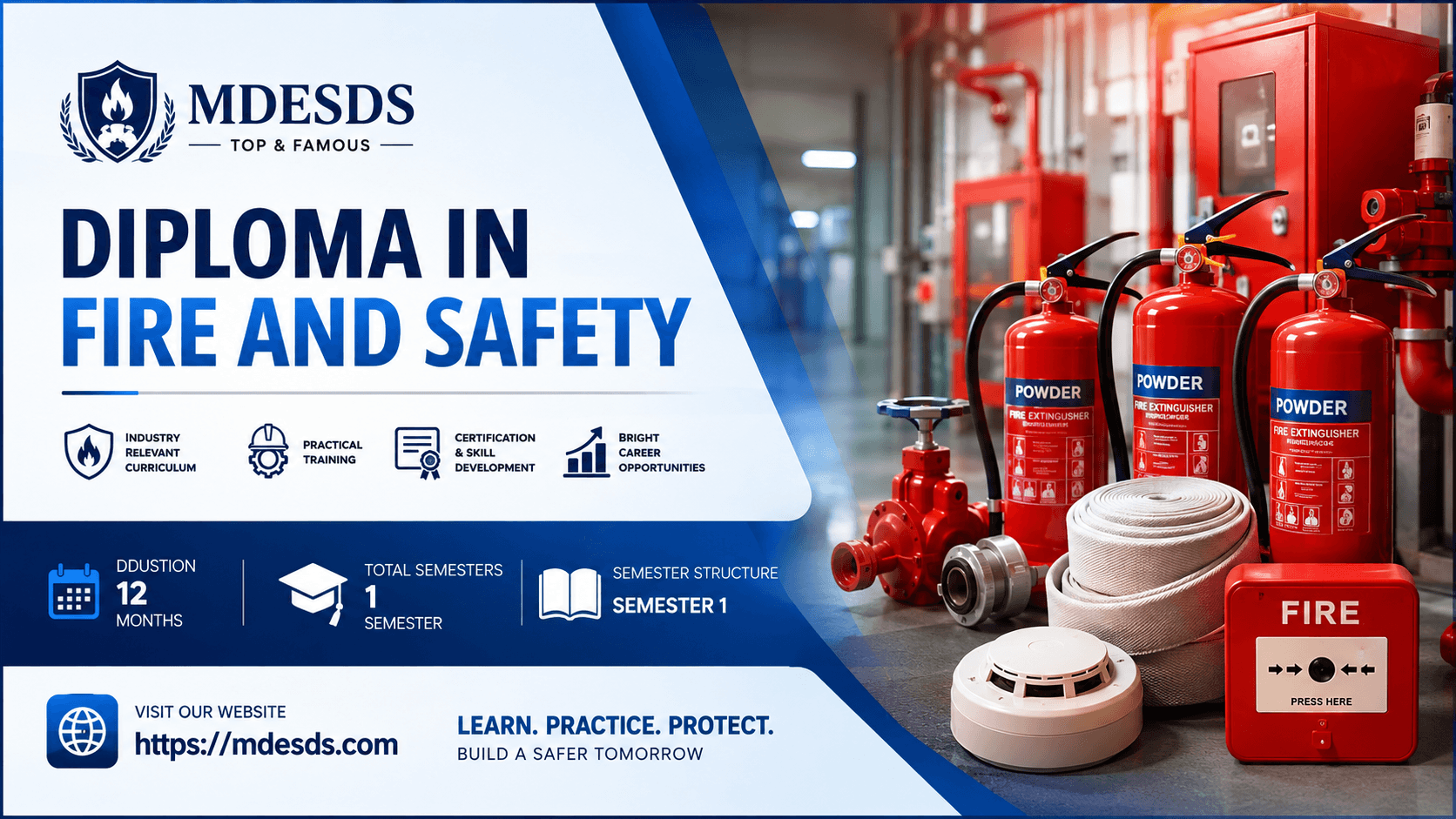
Secure your future with the Diploma In Fire And Safety at MDESDS. 12-month hybrid program covering fire science, industrial safety, and disaster management.
Every year, industrial accidents, commercial property blazes, and structural fires cause devastating financial losses and claim countless innocent lives. Most of these disasters are entirely preventable. As infrastructure expands and manufacturing sectors boom, industries are shifting from reactive firefighting to proactive, highly systematic accident prevention. This shift has created an unprecedented demand for certified professionals who understand the intricate mechanics of hazards.
If you are looking for a career path that offers job security, rapid professional growth, and the profound satisfaction of protecting lives and national assets, the Diploma In Fire And Safety is your gateway. Offered by MDESDS, this program bridges the gap between raw academic concepts and real-world emergency management, preparing you to step confidently into critical safety roles worldwide.
The Diploma In Fire And Safety is a comprehensive, specialized professional program designed to train students in the core principles of risk assessment, fire prevention, hazard control, and emergency response management. This program is not just about learning how to extinguish a fire; it is an all-encompassing discipline focused on designing safer workplaces, implementing regulatory compliance policies, and managing critical infrastructure during chaotic emergencies.
At MDESDS, this specific program is structured as a 12-month program delivered through a flexible hybrid learning mode. This dual approach combines interactive online theoretical lectures with rigorous, hands-on physical drills and campus-based practical simulations. Over its comprehensive duration, students learn to anticipate hazards before they manifest, analyze structural vulnerabilities, and command emergency response operations with absolute military precision.
The structured curriculum of the Diploma In Fire And Safety at MDESDS is meticulously curated by industry veterans and occupational health experts. Spanning a rigorous 12-month program layout, the academic journey is consolidated to maximize field exposure and technical competency.
The program is organized into a deeply focused academic lifecycle that ensures students master fundamental science before moving on to heavy field equipment and strategic disaster deployment frameworks.
The foundational semester focuses heavily on building deep technical knowledge alongside intense physical and tactical preparation. Because this is a 12-month program, the curriculum avoids fluff, dedicating every week of its hybrid learning structure to high-impact, career-ready skills.
Below is an analytical breakdown of the core subjects you will master during this semester, highlighting the explicit practical benefits and distinct industry skills you will walk away with.
This subject strips away the mystery of fire by analyzing it at a molecular level. Students dive deep into the chemistry of combustion, the physics of heat transfer (conduction, convection, and radiation), and the precise classification of fires based on their fuel sources (solid, liquid, gas, electrical, and combustible metals).
Practical Benefits: You will instantly recognize what type of substance is fueling a fire in a real-world crisis, allowing you to choose the exact, safe extinguishing agent. This prevents deadly errors, such as using water on a live electrical or chemical fire, which causes explosive reactions.
Skills Gained: Advanced chemical hazard classification, thermal threat calculation, and rapid identification of explosive environments.
Fire Technology transitions from theory to engineering. This subject details the design, mechanics, and maintenance of modern fire protection systems. Students learn the architecture behind automatic sprinkler networks, fire hydrants, smoke detectors, specialized chemical suppression systems, and portable fire extinguishers.
Practical Benefits: You will possess the architectural knowledge to audit commercial buildings, identify faulty safety designs, and manage complex, automated fire control panels during industrial plant emergencies.
Skills Gained: Operational mastery of active and passive fire suppression systems, blueprint reading for safety exits, and system testing/inspection protocols.
Industrial workplaces—especially refineries, construction sites, and chemical plants—are inherently hazardous. This subject covers risk assessment frameworks, hazardous material handling (HAZMAT), machine guarding, electrical safety, ergonomics, and international safety laws like OSHA and Indian Factory Acts compliance.
Practical Benefits: You will have the training required to draft comprehensive safety manuals, conduct routine accident-prevention audits, and foster a zero-harm workplace culture that saves corporations millions in legal liabilities.
Skills Gained: Job Safety Analysis (JSA), incident reporting, root-cause analysis of industrial accidents, and safety compliance auditing.
When a disaster strikes, emergency responders are the first line of defense before medical doctors arrive. This dual subject teaches cardiopulmonary resuscitation (CPR), trauma handling, burn management, mass casualty triaging, and macro-level evacuation strategies for natural or human-made disasters (earthquakes, gas leaks, terrorist threats).
Practical Benefits: You become an invaluable asset to any community or organization, capable of stabilizing critically injured workers, coordinating smoothly with regional municipal bodies, and preventing panic during large-scale plant evacuations.
Skills Gained: Certified CPR and basic life support (BLS), wound stabilization, mass evacuation planning, and emergency command-center operation.
The finest safety knowledge is useless without rapid, disciplined execution. This practical subject is the physical heart of the hybrid learning experience. Students undergo intense training in synchronized movement, scaling varied structural ladders, deploying high-pressure water hoses, and mastering various coupling fittings.
Practical Benefits: This builds the physical stamina, muscle memory, and composure under pressure required to handle heavy, active fire equipment safely inside smoke-filled structures without injuring yourself or your team.
Skills Gained: High-pressure hose handling, rapid mechanical ladder placement, team synchronization under duress, and knot tying for emergency search and rescue.
The Diploma In Fire And Safety is an exceptionally versatile credential that welcomes individuals from diverse backgrounds. It is custom-tailored for:
Ambitious High School Graduates (10+2): Young students looking to skip traditional, hyper-crowded academic pathways and step into a highly stable, high-paying career field within just a year.
Working Industrial Professionals: Individuals currently working in manufacturing, construction, or warehousing who want to add an official safety specialization to their resume for fast-track promotions into managerial roles.
Defense & Security Personnel: Retired or active security professionals looking to transition smoothly into highly lucrative corporate safety and asset protection jobs.
Career Changers: Anyone with a passion for community service, active physical work, and high-stakes problem-solving who wants to escape standard, stagnant desk environments.
Enrolling in this 12-month program via MDESDS’s flexible hybrid format delivers a wide array of immediate advantages:
Rapid Industry Integration: Unlike lengthy three or four-year degree plans, this diploma condenses elite, job-ready knowledge into a single year, saving you time and getting you into a paying role much faster.
Unwavering Global Relevance: Fire safety protocols are universal. The skills you master regarding risk mitigation, safety audits, and rescue technology transfer seamlessly to corporate offices and industrial hubs anywhere in the world.
A High-Impact Professional Network: Through the hybrid learning model, you connect directly with active field experts, regulatory auditors, and seasoned fire chiefs, opening direct pathways to unadvertised industry openings.
Official Professional Distinction: Graduating from a structured program elevates you instantly above self-taught individuals, granting you the credibility needed to represent corporate entities before government safety inspectors.
The career landscape after completing your Diploma In Fire And Safety is vast and spans across multiple high-value sectors, including oil and gas refineries, airports, construction companies, heavy manufacturing industries, seaports, and hospitality mega-complexes.
Graduates can step into a variety of specialized professional roles:
Safety Officer / HSE Officer: Monitoring daily industrial plant operations, verifying worker compliance with protective gear, and maintaining safety logs.
Fire Auditor / Fire Risk Assessor: Conducting structural evaluations for corporate properties, checking system designs, and issuing official hazard clearances.
Fire Station Commander / Marshal: Leading tactical response teams directly within municipal fire departments, large airports, or private refinery fire stations.
Safety Supervisor / Manager: Designing macro-level corporate environmental health and safety (EHS) policies and overseeing a team of field officers.
Risk Management Consultant: Working hand-in-hand with commercial insurance giants to evaluate potential property hazards before high-value policies are signed off.
MDESDS stands out as a premier institution for professional education, recognized for its commitment to student success and academic excellence.
Elite Hybrid Learning Infrastructure: MDESDS has perfected the hybrid education delivery method. You study complex theory from the comfort of your home, then report for intensive, structured practical labs and live drills that simulate true workplace emergencies.
A Modern, Industry-Aligned Curriculum: Our course material is continuously updated to reflect the latest changes in international safety laws, emerging eco-friendly fire suppression technologies, and current industrial hazard patterns.
Experienced, Veteran Mentorship: You won't just learn from textbooks. Classes at MDESDS are led by active safety consultants, retired fire service personnel, and legal compliance experts who bring real-world case studies into the classroom.
Comprehensive Placement Assistance: Our dedicated corporate relations cell works to connect bright graduates with top employers in manufacturing, construction, and corporate real estate across the country.
Do not leave your professional future to chance. Step into a fulfilling, stable, and highly respected career field that lets you protect communities and save lives every single day. Secure your seat in our next batch today.
The Diploma In Fire And Safety course is designed to provide practical knowledge, professional skills, and industry-relevant training. With a duration of 12 Months, this program helps students develop the expertise required for academic and professional success.

Master essential digital skills with the 3-month Certificate In Basic Computer course by MDESDS. Enroll today to boost y...
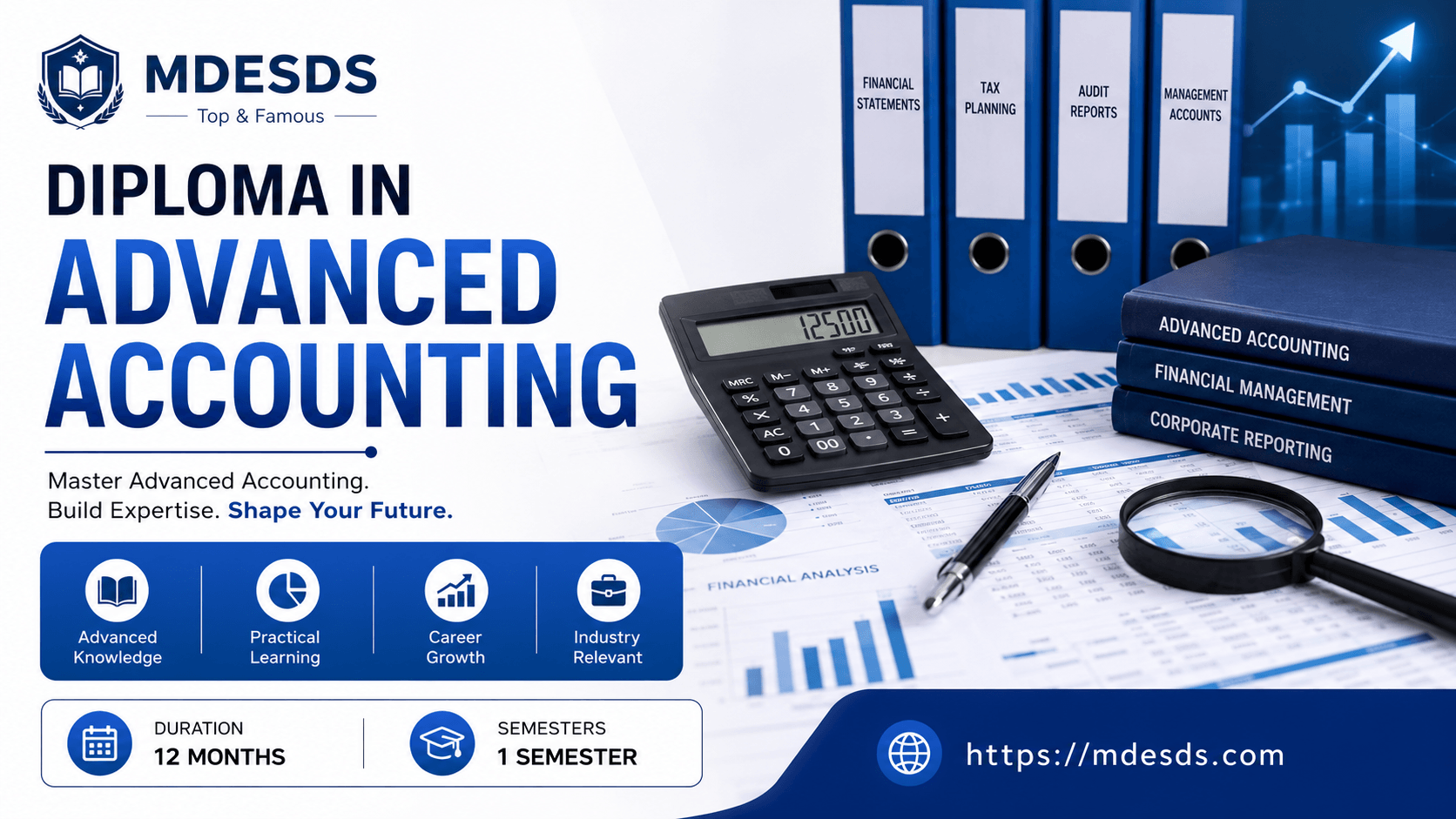
Master corporate finance with our 12-month Diploma In Advanced Accounting at MDESDS. Enjoy hybrid learning, manual accou...

Master culinary skills, bakery, and hygiene with our 12-month hybrid Diploma In Food Processing at MDESDS. Start your gl...
Join MDESDS and build a successful future with industry-recognized diploma, certificate, vocational, and professional training programs. Limited seats available for the current academic session. Apply today and take the next step toward your career goals.