Applications are now open for the Academic Session 2026-27.
Open
Applications are now open for the Academic Session 2026-27.
Applications are now open for the Academic Session 2026-27.
Applications are now open for the Academic Session 2026-27.

Master core electronics, CAD, and electrical machines with the 12-month hybrid Diploma in Electronics Technology at MDESDS. Start your engineering career today.
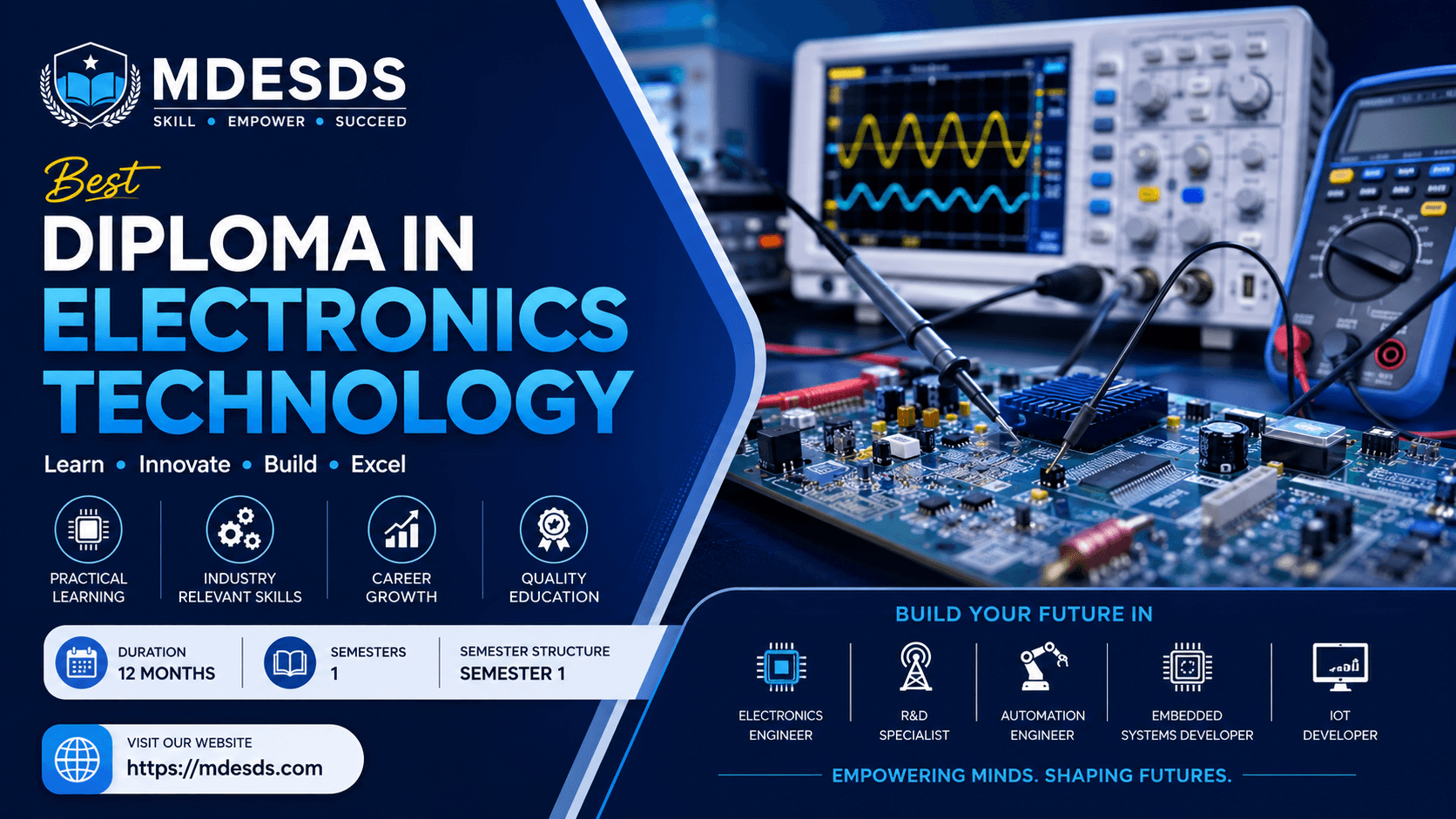
The modern world runs on smart devices, automated systems, and interconnected hardware. From the smartphone in your hand to the massive industrial robots powering manufacturing plants, electronics technology is the backbone of global innovation. As industries rapidly transition toward automation, internet of things (IoT), and electric vehicles, the demand for skilled electronics professionals has never been higher.
If you are passionate about understanding how things work, building circuits, and solving complex technical problems, pursuing a Diploma In Electronics Technology is your perfect stepping stone.
Offered by MDESDS, this comprehensive program is meticulously designed to bridge the gap between theoretical engineering concepts and real-world industrial applications. Whether you are a high school graduate looking for a future-proof career or a working professional aiming to upscale your technical skills, this course provides the perfect platform to launch a successful career in the fast-growing engineering sector.
A Diploma In Electronics Technology is a specialized technical program that focuses on the design, testing, installation, and maintenance of electronic circuits and electrical systems. Unlike purely theoretical degrees, a diploma program emphasizes practical, hands-on learning. It equips students with a deep understanding of analog and digital electronics, electrical machines, and modern computer-aided design tools.
At MDESDS, this curriculum is delivered through a flexible hybrid learning mode. This means students get the best of both worlds: high-quality, flexible theoretical online learning combined with essential on-site practical training and workshops. Spanning a focused duration of 12 months, the program is structured to fast-track your entry into the engineering workforce without compromising on educational depth or technical rigor.
The Diploma In Electronics Technology at MDESDS is structured into an intensive curriculum that maximizes learning outcomes within its 12-month duration. The program is systematically organized to build your skills from the ground up.
The program structure ensures that foundational concepts are seamlessly integrated with advanced technical applications. Let us explore the specific modules and subjects you will master during your academic year.
The first phase of the program establishes a rock-solid foundation in both electrical principles and modern engineering design tools. Here is a detailed breakdown of the subjects you will study, the practical benefits they offer, and the real-world skills you will gain.
What You Will Learn: This subject covers the fundamental principles of alternating current (AC) and direct current (DC) circuits, Ohm’s law, Kirchhoff’s laws, network theorems, and basic electrical safety protocols.
Practical Benefits: Understanding electrical fundamentals is crucial before working on any electronic hardware. It allows you to safely analyze grid power, troubleshoot power supplies, and understand electricity distribution.
Skills Gained: Circuit analysis, multimeter troubleshooting, electrical safety auditing, and wiring diagram interpretation.
What You Will Learn: Dive deep into the world of semiconductor devices, including diodes, transistors (BJTs and MOSFETs), operational amplifiers, and digital logic gates.
Practical Benefits: Electronics is the heart of this entire program. This subject allows you to understand how microchips process information and how components regulate voltages in modern consumer gadgets.
Skills Gained: Breadboard prototyping, PCB (Printed Circuit Board) testing, soldering, and diagnosing faulty electronic components.
What You Will Learn: An introduction to industry-standard computer-aided design software used to create blueprint layouts for electrical panels and electronic schematics.
Practical Benefits: Modern engineers do not draw blueprints by hand. Mastering CAD ensures you can create professional blueprints that manufacturing teams can read and execute flawlessly.
Skills Gained: 2D and 3D engineering modeling, schematic capturing, digital blueprint generation, and design-rule checking.
What You Will Learn: Study the inner workings, construction, and control mechanisms of transformers, DC motors, synchronous motors, and induction motors.
Practical Benefits: Electric motors run the modern industrial world and power the electric vehicle (EV) revolution. Knowing how to maintain, control, and optimize these machines makes you highly valuable to automation and automotive employers.
Skills Gained: Motor speed control, transformer testing, fault detection in rotating machines, and industrial motor installation.
What You Will Learn: Focuses on practical mathematical tools, including calculus, complex numbers, and differential equations tailored specifically for engineering problems.
Practical Benefits: Math provides the language to calculate exact component values, predict circuit behaviors, and analyze signal frequencies without risking expensive hardware damage.
Skills Gained: Advanced problem-solving, analytical data calculation, and quantitative frequency analysis.
The Diploma In Electronics Technology is a versatile program designed for a wide spectrum of learners. It is an ideal fit for:
High School Graduates: Students looking for an affordable, rapid, and job-oriented career path in engineering rather than spending four years on traditional degrees.
IT professionals and Technicians: Existing field technicians or electric line workers who want to validate their experience with an official certification and move up into supervisory roles.
Aspiring Entrepreneurs: Individuals who want to start their own electronic repair, manufacturing, or solar installation businesses and need verified technical know-how.
Tech Hobbyists: Anyone fascinated by robotics, home automation, or hardware engineering who wants to turn a personal hobby into a high-paying professional career.
Enrolling in the Diploma In Electronics Technology program offers distinct advantages that can significantly alter your professional trajectory:
Accelerated Entry to Industry: Traditional engineering degrees take up to four years. Our program delivers highly focused, industry-relevant training in just 12 months, saving you time and tuition costs.
True Hybrid Learning Mode Flexibility: Our modern hybrid approach ensures your studies fit around your existing lifestyle. Learn your theoretical frameworks online whenever it suits you, and attend localized workshops for your practical tool sessions.
Industry-Aligned Skills: The curriculum focuses directly on what modern hiring managers look for—such as CAD skills and electrical machine handling—rather than outdated historical theories.
Confidence with Professional Tools: You will graduate knowing exactly how to use professional software and lab equipment, minimizing the learning curve when you start your first job.
The career scope after completing a Diploma In Electronics Technology is exceptionally broad, spanning industries like aerospace, telecommunications, consumer electronics, green energy, and automotive manufacturing.
Electronics Test Technician: Calibrating, testing, and troubleshooting electronic hardware setups during factory production.
CAD Drafter / Design Assistant: Utilizing software tools to draw up electrical layouts for commercial construction projects or industrial installations.
Electrical Maintenance Supervisor: Overseeing the operations, safety cycles, and upkeep of massive electrical machines and power systems within factories.
Field Service Engineer: Traveling to client sites to install, repair, and maintain specialized electronic equipment, medical devices, or telecom towers.
Control and Instrumentation Technician: Managing the automated sensors and circuit loops that control modern robotic assembly lines.
If you decide to study further down the line, this 12-month diploma provides an incredible foundation. You can easily transition into advanced engineering certifications, specialized robotics paths, or corporate management tracks with a distinct practical edge over your peers.
MDESDS stands out as a premier institute dedicated to delivering accessible, career-focused technical education. We believe that learning should be practical, affordable, and closely aligned with current industry standards.
When you choose MDESDS for your Diploma In Electronics Technology, you are investing in an educational ecosystem that prioritizes student outcomes. Our hybrid learning mode is powered by intuitive digital portals and supported by experienced educators who understand what it takes to succeed in the real world. With balanced continuous assessments, dedicated technical support, and a reputation for producing industry-ready professionals, MDESDS is the partner you need to secure your future.
Don't wait to build the technical career you have always wanted. Spaces for our upcoming cohort are limited. Take the definitive first step toward becoming a qualified electronics professional right now.
The Diploma In Electronics Technology course is designed to provide practical knowledge, professional skills, and industry-relevant training. With a duration of 12, this program helps students develop the expertise required for academic and professional success.

Advance your career with our 24-month hybrid Diploma In Laboratory Techniques And Animal Care. Gain hands-on skills. Enr...
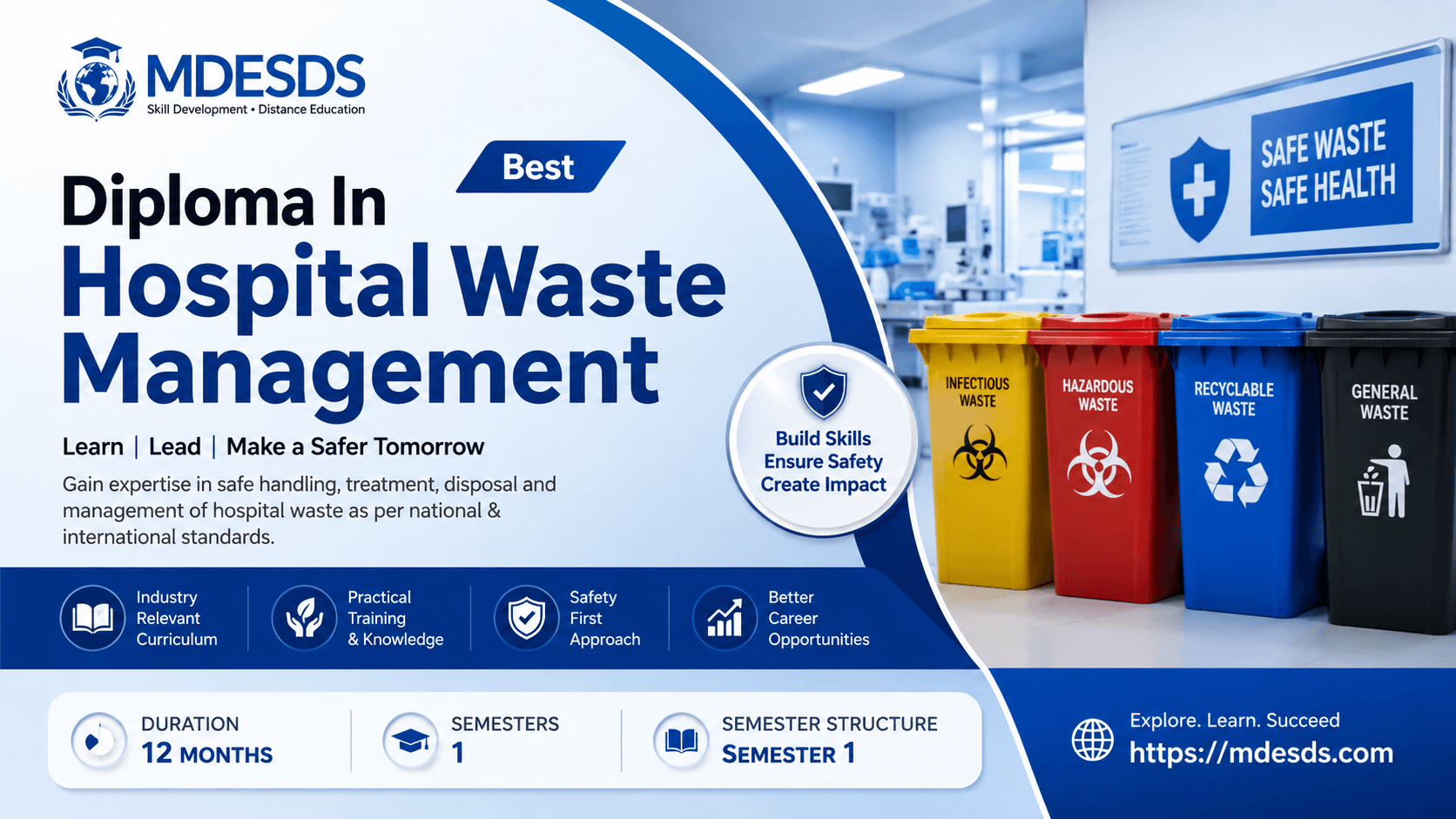
Master bio-medical waste handling with MDESDS's 12-month hybrid Diploma In Hospital Waste Management. Build a rewarding ...
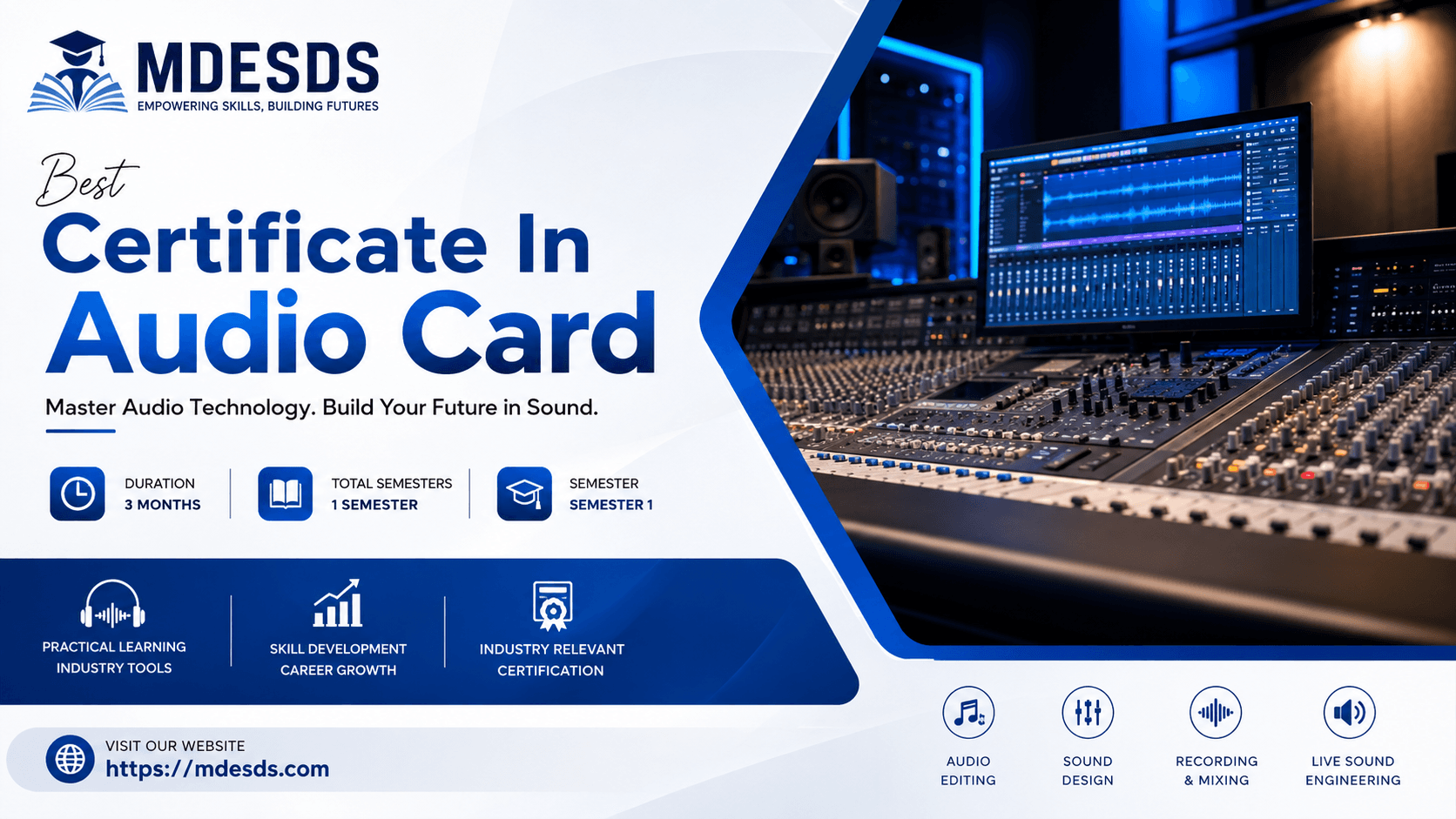
Elevate your technical design skills with our 3-month hybrid Certificate In Audio Card at MDESDS. Master mechanical draf...