Applications are now open for the Academic Session 2026-27.
Open
Applications are now open for the Academic Session 2026-27.
Applications are now open for the Academic Session 2026-27.
Applications are now open for the Academic Session 2026-27.

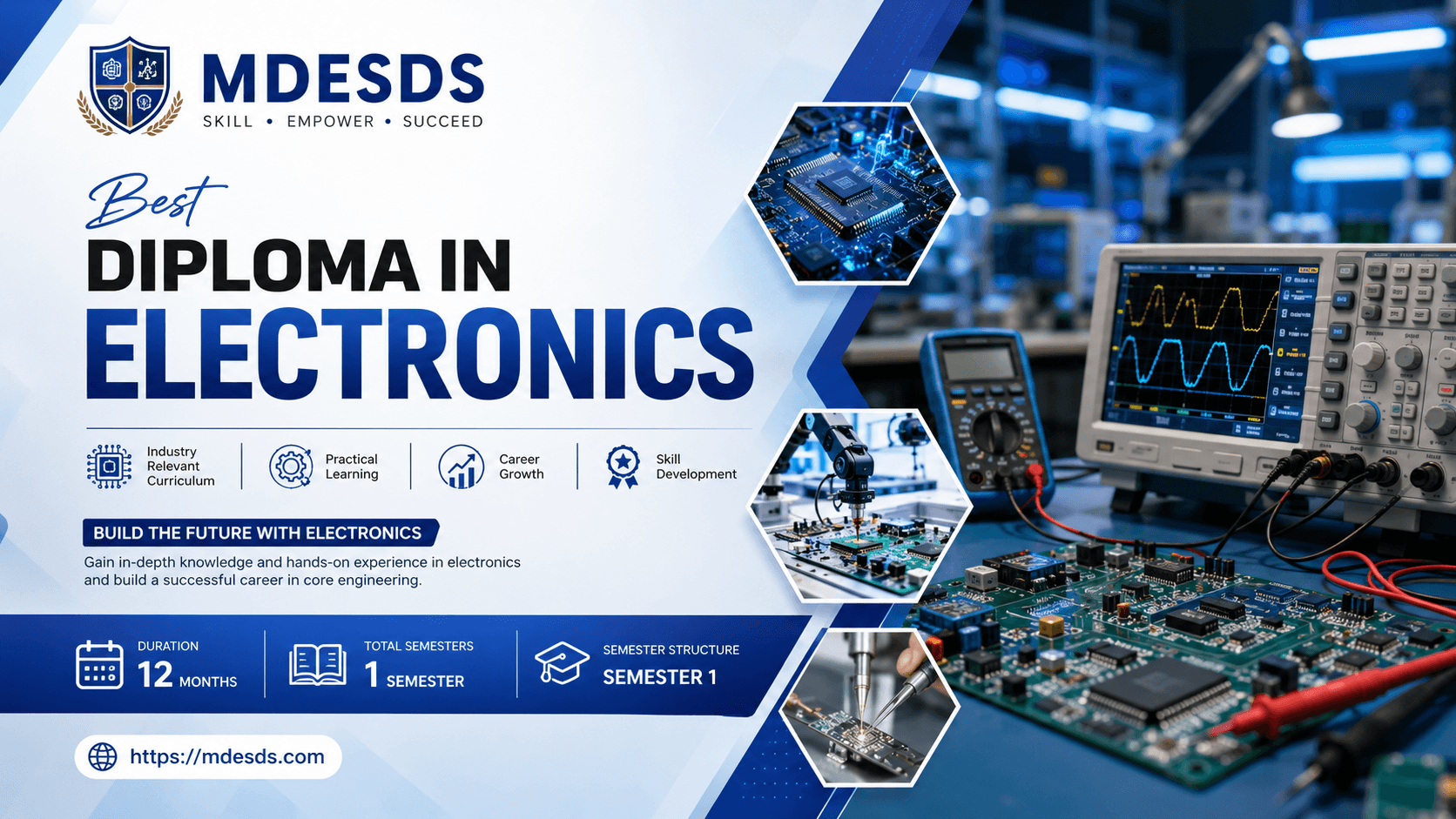
Gain hands-on engineering skills with our 12-month hybrid Diploma In Electronics. Explore the syllabus, career options, and expert training at MDESDS.
The modern world runs on electronics. From the smartphone in your hand and the smart appliances in your home to the complex control systems powering global industries, electronic circuits are the invisible backbone of modern civilization. As technologies like automation, renewable energy, and smart infrastructure continue to expand rapidly, the demand for skilled electronics professionals has never been higher.
To bridge the gap between academic theory and real-world engineering needs, MDESDS offers a comprehensive industry-oriented program: the Diploma In Electronics. Designed by technical experts, this program serves as a launchpad for aspiring technicians, engineers, and tech entrepreneurs who want to build a rock-solid foundation in hardware design, troubleshooting, and electronic communication systems.
Choosing a career path in this domain opens up incredible global opportunities. However, true success requires a learning environment that balances conceptual knowledge with extensive practical application. This page breaks down everything you need to know about this professional training program, what you will learn, and how it can transform your career trajectory.
A Diploma In Electronics is a specialized technical program focused on teaching the principles of electrical circuits, semiconductor devices, digital systems, and data communication. Unlike purely theoretical degrees, a diploma program is specifically engineered to provide operational excellence. It prepares students to design, assemble, test, maintain, and repair a massive variety of electronic components and machinery.
At MDESDS, this structured program spans a duration of 12 months. Recognizing the busy schedules of modern learners, professionals, and students alike, the training is delivered via a highly flexible hybrid learning mode. This hybrid model perfectly blends interactive online theoretical lectures with vital on-campus practical labs. Over the course of 12 months, students progress from foundational science concepts to advanced digital communication networks, making them immediately employable upon graduation.
The Diploma In Electronics at MDESDS is meticulously divided across its training timeline to ensure a seamless learning curve. The curriculum focuses heavily on core core principles and practical deployment. Below is the detailed breakdown of the curriculum, including the specialized subjects you will master during Semester 1.
The first phase of the course establishes the fundamental baseline for all electronics engineering applications. Students dive deep into the physics of materials, circuit analysis, and both analog and digital signaling methods.
Applied Physics
Practical Benefits: Electronics is fundamentally applied physics. This subject teaches you how electrons behave within different materials under varying forces. Understanding wave mechanics, semiconductor properties, and electromagnetism allows you to predict how circuits will perform in real-world environments.
Skills Gained: Ability to analyze electromagnetic interference (EMI), map electrical fields, calculate thermal dissipation in components, and apply physical laws to solve hardware engineering bottlenecks.
Communication Skills
Practical Benefits: Technical brilliance can be restricted without clear communication. Engineers must regularly draft technical reports, explain complex malfunctions to clients, and collaborate effectively within cross-functional teams. This module ensures you can convey data clearly and professionally.
Skills Gained: Technical report writing, reading complex architectural blueprints, professional presentation abilities, collaborative team communication, and clear client-handling protocols.
Engineering Linear
Practical Benefits: This subject focuses heavily on linear integrated circuits, operational amplifiers (Op-Amps), and analog circuit design. These components are essential for signal processing, filtering out background noise, and amplifying signals in audio equipment, medical devices, and industrial sensors.
Skills Gained: Designing stable amplifier circuits, working with analog-to-digital converters, filtering electrical noise, and mastering waveforms using oscillators.
Laboratory Digital Communication
Practical Benefits: Modern data transfer is entirely digital. This hands-on laboratory subject introduces you to modulation, coding techniques, data packets, and error detection systems. You will learn how clear, uncorrupted data travels from a transmitter to a receiver across fiber optics, copper cables, or wireless frequencies.
Skills Gained: Calibration of digital testing equipment, implementing pulse-code modulation (PCM), analyzing signal-to-noise ratios (SNR), and configuring digital transceivers.
Electronic Devices And Circuits
Practical Benefits: This core subject explores the foundational building blocks of all hardware: diodes, transistors (BJTs and MOSFETs), rectifiers, and power supplies. Mastering these devices lets you diagnose hardware failures down to the exact failed chip on a circuit board.
Skills Gained: Blueprint reading, component testing using multimeters and oscilloscopes, circuit board troubleshooting, soldering, and designing efficient power management systems.
The Diploma In Electronics program is highly versatile and accommodates a broad range of career goals. It is highly recommended for:
High School Graduates: Students who have finished their 10th or 12th standard with a science background and want a fast-track, direct path into a highly secure engineering field.
Aspiring Hardware Technicians: Individuals already working informally with hardware repairs who want a universally recognized professional certification to back their skills.
Working Professionals: Technicians looking to upgrade their knowledge from traditional analog machinery to modern digital communication systems.
Tech Hobbyists and Entrepreneurs: Anyone eager to build their own hardware products, IoT (Internet of Things) devices, or launch a tech repair and consultancy business.
Enrolling in this specialized 12 months course yields significant structural advantages for your long-term career growth:
Flexible Hybrid Learning Mode: You do not have to put your life or job on hold. Balance web-based conceptual learning with focused, hands-on physical labs.
Industry-Aligned Curriculum: Every single subject is tailored to reflect current market requirements, ensuring you learn technologies actively used by modern employers.
Rapid Career Entry: Instead of spending 3 to 4 years in a highly theoretical degree program, this focused course makes you job-ready in exactly one year.
Heavy Focus on Practical Competencies: With dedicated lab work like the Laboratory Digital Communication module, you spend substantial time working directly with real components and diagnostic tools.
The career trajectory for individuals possessing a Diploma In Electronics is diverse and expanding. As smart automation takes over manufacturing, infrastructure, and consumer goods, certified professionals find opportunities across multiple sectors.
Electronics Tech Support Specialist: Maintaining and installing office, healthcare, and industrial electronic infrastructure.
Hardware Test Engineer: Working alongside development teams in manufacturing plants to run quality control tests on newly assembled circuit boards.
Communications Technician: Installing, configuring, and maintaining digital transmission systems, telecom towers, and fiber optic data lines.
Service and Repair Engineer: Diagnosing component-level faults in consumer appliances, medical equipment, and automotive computing modules.
Completing this program opens up multiple avenues for advanced learning. Graduates can pursue lateral entry into full-scale electrical engineering degrees or transition seamlessly into highly lucrative niches like robotics, smart IoT networks, renewable energy grid management, and electric vehicle (EV) battery infrastructure maintenance.
MDESDS stands out as a leading technical training institute committed to student empowerment and excellence. When you choose us for your education, you gain access to an unparalleled support system:
Expert Faculty: Learn from experienced engineering professionals who bring real-world industry problems into the classroom.
State-of-the-Art Labs: Work with advanced diagnostics, industrial oscilloscopes, and signaling kits to build confidence before stepping into the field.
Comprehensive Student Support: MDESDS provides complete career assistance, resume workshops, and interview preparation to help you land your dream job seamlessly.
Affordable, Accessible Quality Education: High-tier engineering mentorship delivered through an optimized system that values your time and financial investment.
Do not leave your professional future to chance. Equip yourself with the hands-on engineering skills demanded by top global tech firms. Your pathway to becoming a skilled hardware and communications professional starts right here at MDESDS.
The Diploma In Electronics course is designed to provide practical knowledge, professional skills, and industry-relevant training. With a duration of 12, this program helps students develop the expertise required for academic and professional success.
Elevate your IT career with the Advance Diploma In Computer Programming And Application at MDESDS. Master coding, networ...

Upgrade your career with the Advance Diploma In Business Management at MDESDS. A 24-month hybrid program featuring entre...
Elevate your medical career with the 12-month Advance Diploma In Health Care by MDESDS. Master patient care, hospital pl...